The product
Solnix AI Telecom Suite
Network, field and retention agents that fix outages before customers call..
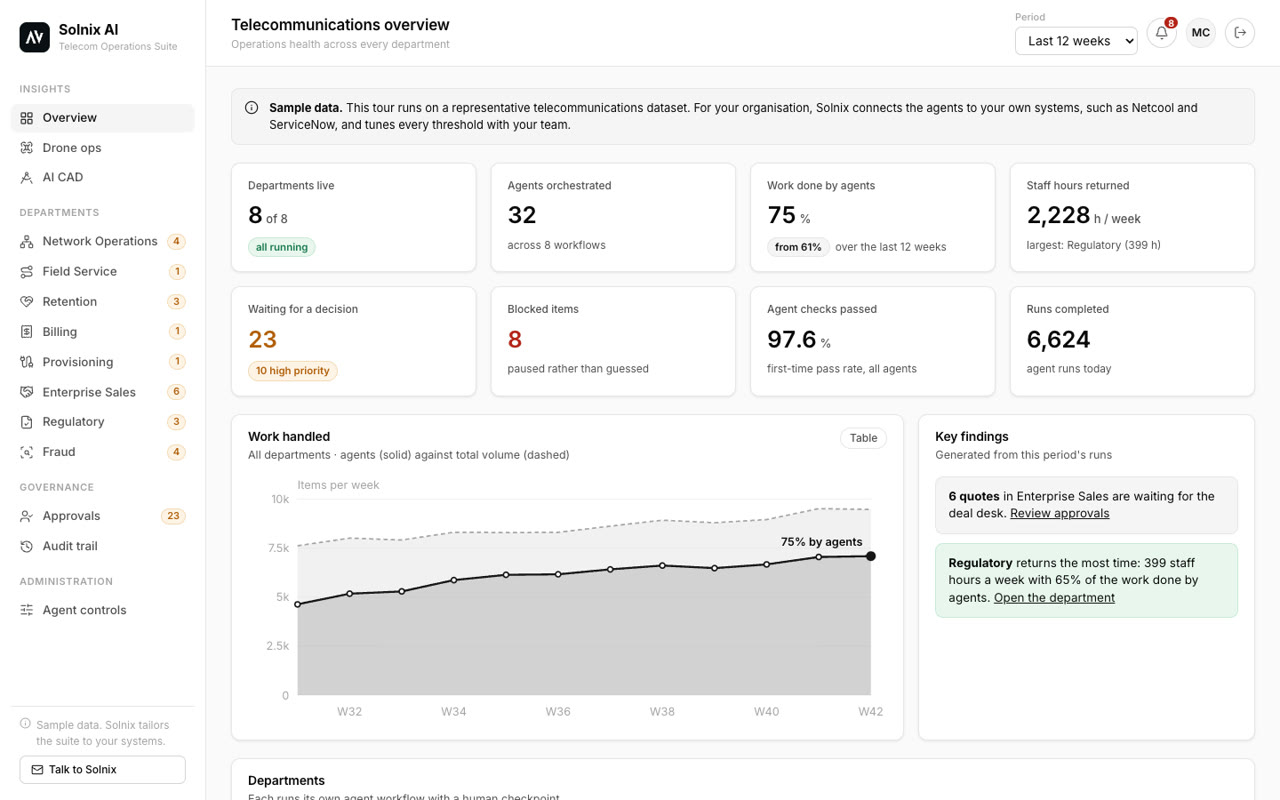
One dashboard for every telecommunications department. Each department runs its own team of agents on the systems you already use. They handle the routine steps, stop at a checkpoint for the decisions your people own, and record every step for audit.
In the field
Drone ops and AI CAD in the Telecom suite
Inside the suite
Pick a department to see how its agents work
NOC Incident Commander
Correlates alarms into incidents, finds root cause across RAN, transport and core, and runs remediation playbooks.
- 1Starts whenAlarm storm on OSS
- 2AgentCorrelate Agent
- 3AgentRCA Agent
- 4AgentRemediate Agent
- 5AgentComms Agent
- 6CheckpointNOC engineer approves
- 7ThenSystems are updated and the run is saved to the audit trail
Questions about the Telecom suite
What is the Solnix AI Telecom Suite?
The Solnix AI Telecom Suite is an agent dashboard for telecommunications with 8 department dashboards and 32 specialised AI agents. Network, field and retention agents that fix outages before customers call.
Which departments does the Telecom suite cover?
NOC Incident Commander, Technician Dispatch, Churn Save Desk, Bill Dispute Resolver, Order Fallout Fixer, Enterprise Deal Desk, Spectrum & Compliance Tracker and SIM Swap Shield. Each runs its own agent workflow with a human checkpoint and an audit trail.
What does the NOC Incident Commander workflow do?
Correlates alarms into incidents, finds root cause across RAN, transport and core, and runs remediation playbooks. It starts when alarm storm on OSS, runs 4 agents (Correlate Agent, RCA Agent, Remediate Agent, Comms Agent) and stops for the nOC engineer to approve.
Does the Telecom suite include drone inspection?
Yes. Drone ops in the Telecom suite runs missions such as tower audit · HYD-0412: antennas verified; corrosion, loose cable and nest flagged. It also includes AI CAD, for example 40 m lattice tower.
How can I try the Telecom suite?
Open https://enterprise.solnixmedia.com/telecom and verify a work email for a 14-day guided tour on sample telecommunications data.
The Challenge
Speed, signal, and scale define winners in high-tech
Engineering velocity, customer insight gaps, and GTM inefficiency are the compounding constraints limiting growth.
Engineering Productivity Ceiling
As codebases grow, developer productivity stagnates, more time debugging legacy code, reviewing PRs, and writing tests than shipping features. The engineering-to-output ratio worsens with scale.
Customer Signal Fragmentation
Product signal lives in support tickets, NPS surveys, sales call transcripts, G2 reviews, and Reddit threads. Without AI synthesis, PMs make decisions based on the loudest voices rather than systematic evidence.
Support Cost Scaling
Technical support costs scale linearly with customer growth. Self-serve deflection rates plateau at 30–40% with legacy chatbots that can't answer technical questions accurately.
GTM Inefficiency
Sales engineers spend 60% of their time on repetitive demo customization and RFP responses. Solutions engineering is a bottleneck for enterprise deal velocity.
Education AI Solutions
AI systems for product, engineering, and GTM teams
Code Intelligence & Review AI
AI code review, test generation, and documentation that integrates with GitHub/GitLab, reducing review cycle time and catching bugs before they reach production.
Product Signal Synthesis
AI that ingests support tickets, NPS responses, sales call transcripts, and app store reviews to surface prioritized product insights, giving PMs a real-time signal layer.
Technical Support AI
AI support agents trained on your documentation, codebase, and resolved tickets, handling Tier 1 and Tier 2 technical questions with 85%+ deflection rates.
Sales Engineering Automation
AI that generates customized demo environments, RFP responses, and technical proposals, freeing solutions engineers for high-value customer conversations.
Competitive Intelligence AI
Real-time monitoring of competitor product updates, pricing changes, review site sentiment, and job postings, synthesized into weekly battlecard updates for sales and product.
Developer Relations AI
AI that monitors developer community signals, auto-responds to GitHub issues, and surfaces documentation gaps, helping DevRel teams scale community engagement without linear headcount growth.
End-to-End Implementation
End-to-end AI implementation for high-tech
Solnix delivers the full lifecycle, from opportunity mapping through production deployment and continuous improvement. The same proven methodology powers every high-tech engagement, tailored to your systems, data, and regulatory environment.
Discovery & AI Opportunity Mapping
We start by understanding your operations, data landscape, and goals, then map where AI delivers measurable value and where it does not. Every engagement begins with a prioritized opportunity backlog, not a technology pitch.
Data Foundation & Readiness
AI is only as good as the data behind it. We assess data quality, connect fragmented sources, and build the secure, governed pipelines that production AI depends on, with privacy and compliance designed in from the start.
Model & Agent Development
We build the models, retrieval systems, and AI agents tailored to your use cases, selecting the right approach (fine-tuning, RAG, multi-agent orchestration) for accuracy, cost, and latency, and validating against your real-world edge cases.
Integration & Workflow Embedding
AI only creates value when it lives inside the tools your teams already use. We embed models and agents into existing systems, surfaces, and workflows, so adoption is natural and human-in-the-loop controls stay in place.
Deployment, Security & Compliance
We deploy to production with the security, monitoring, and compliance controls enterprises require, including bias and fairness testing, audit logging, and the observability needed to operate AI responsibly at scale.
Optimization & Continuous Improvement
AI systems improve with use. We measure outcomes against the goals set in Phase 01, retrain and tune from live feedback, and expand to the next set of use cases, turning a single deployment into a compounding capability.
Methodology
How Solnix Builds for High-Tech
01, Engineering Stack Assessment
01, Engineering Stack Assessment
We audit your existing toolchain. CI/CD, code review, testing, monitoring, and identify the highest-leverage AI integration points before proposing any new infrastructure.
02, Codebase & Knowledge Ingestion
02, Codebase & Knowledge Ingestion
AI systems are trained on your proprietary codebase, documentation, and support history, so they produce contextually relevant outputs rather than generic responses.
03, Developer-First Integration
03, Developer-First Integration
We integrate AI directly into existing developer workflows. GitHub, Jira, Slack, VS Code, rather than requiring workflow changes. Adoption happens where engineers already work.
04, Security & IP Protection
04, Security & IP Protection
All code and proprietary documentation is processed within private, access-controlled infrastructure. We implement strict data isolation and do not use client IP to train shared models.
05, Iteration & Model Improvement
05, Iteration & Model Improvement
High-tech AI systems improve rapidly with usage. We build active learning loops that incorporate developer feedback and support resolution data into continuous model improvement cycles.
FAQ
Questions from CTOs, VPs of Product, and GTM leaders
Get Started
Ship Faster. Know Your Customer Better.
Solnix builds high-tech AI that gives engineering, product, and GTM teams the leverage to outpace competitors on every dimension that matters.
Request a Tech AI Assessment →