Whitepapers on Solnix Enterprise, AI Feeder, Drone ops, AI CAD, AeroPulse, MCP servers and our growth services, plus the frameworks we use for strategy, architecture and governance. Each paper shows the product, what Solnix has built that you can check, and how it compares with the alternatives. Request one and every document of the full paper arrives in your inbox.
ProductOctober 2026· 4 documents · 32 pages
Solnix Enterprise: Agent Suites for Every Department
How 17 industry suites put a dashboard and a team of AI agents in every department, with a human checkpoint and an audit trail on every run.
Abstract
Solnix Enterprise is a set of 17 industry suites. Each suite gives every department its own dashboard and its own chain of AI agents. Agents do the routine steps on the systems you already run, stop at a checkpoint for the decisions your people own, and record every step. This paper explains the run pattern, the controls, the full catalogue of 137 department workflows, and how the approach compares with platform vendors and large integrators.
Key findings
0117 industry suites and 137 department dashboards, each with a defined trigger, agent chain and named checkpoint.
02Every run follows the same pattern: trigger, specialist agents, human checkpoint, systems updated, audit trail.
03Autonomy is set per agent (assist, supervised or autonomous) with a confidence floor below which the agent must ask.
04Unlike general-purpose agent platforms, the starting point is the industry's own departments, not a blank builder.
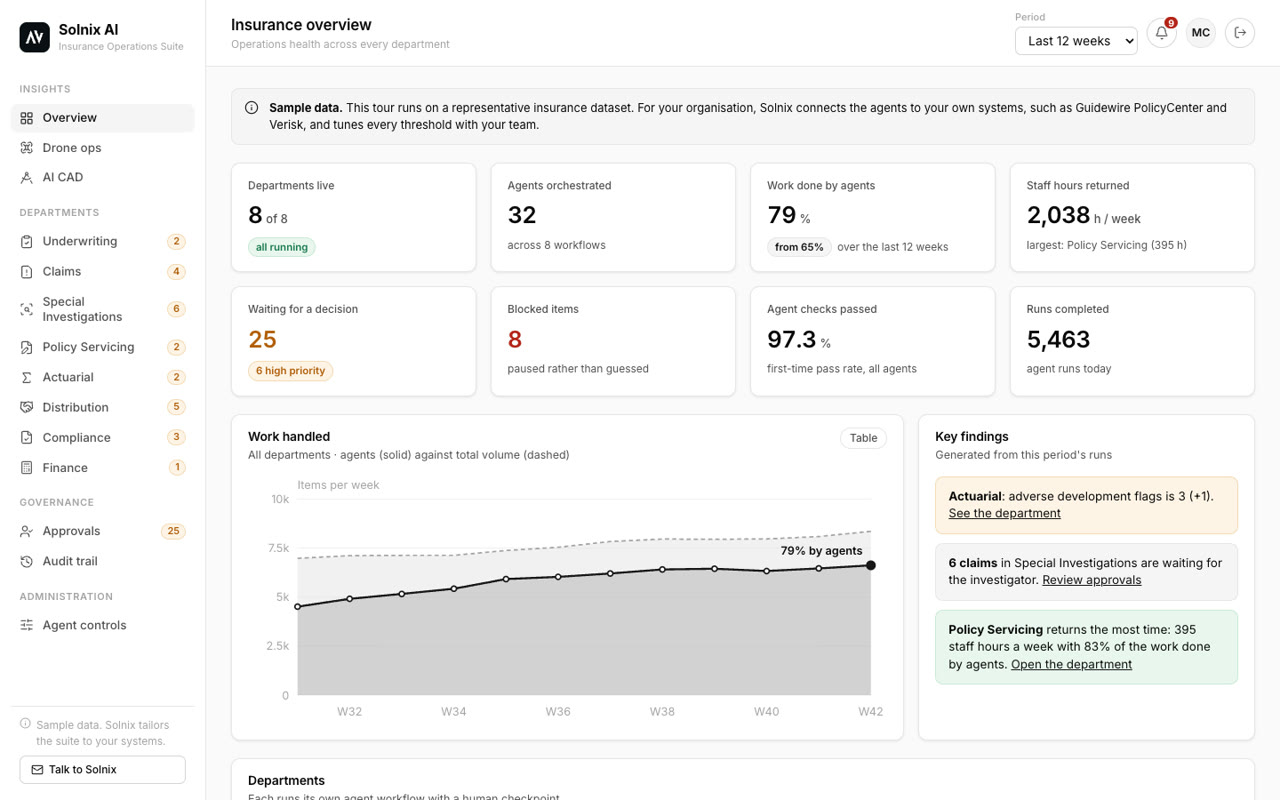
The 17 industry suites and the number of department dashboards in each.
Inside this paper
One suite per industry, one dashboard per department
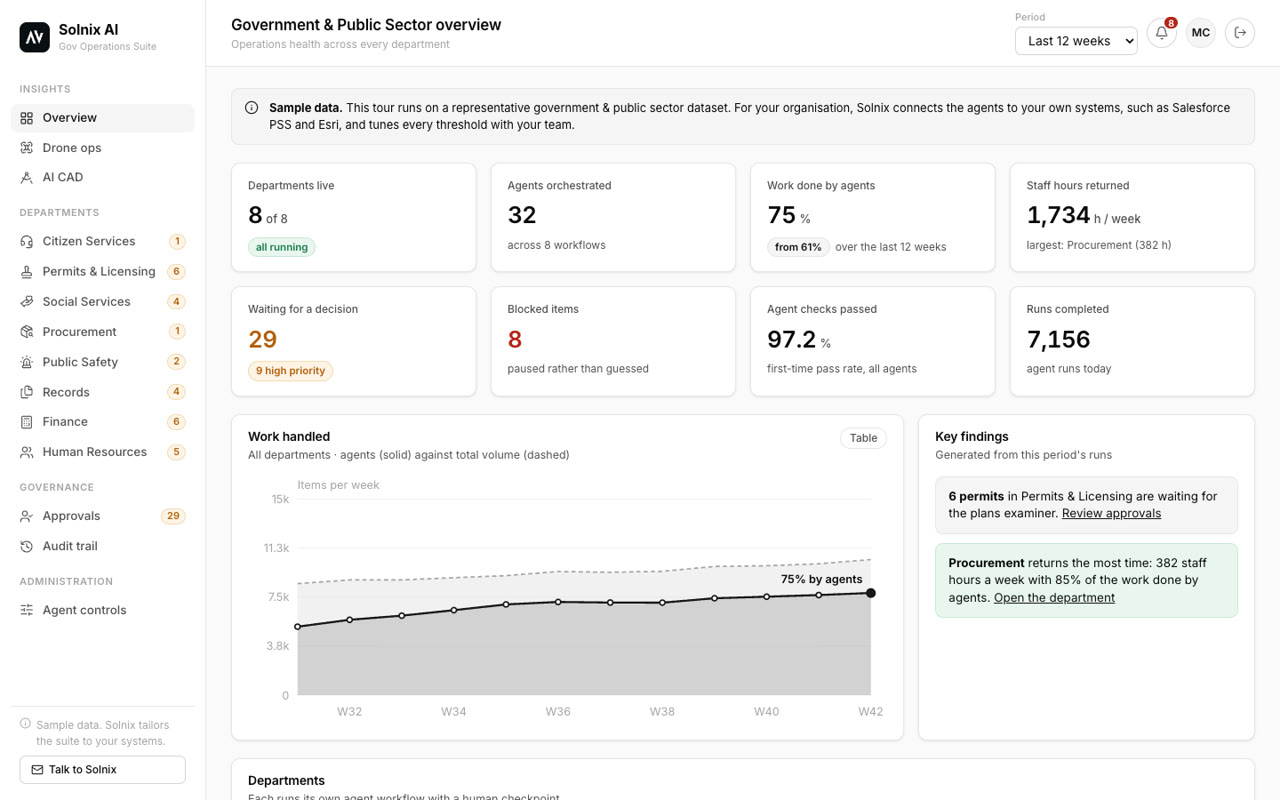
Each suite is organised around the departments of its industry, with the queue of work its agents are handling, what is waiting for a person and what is blocked.
The run pattern and its controls
Approvals, the audit trail and agent controls are shared by every suite, so governance does not have to be rebuilt per use case.
How it compares
Set against Palantir, ServiceNow, Salesforce Agentforce, Microsoft Copilot Studio and UiPath by starting point, industry depth, checkpoints and ownership.
The full paper, as 4 documents
Part 1Platform overviewWhat a suite is, how a run works and what the command centres show.7 pp
Part 2Governance, approvals and agent controlsThe three shared pages that keep people in charge, and how autonomy is set.3 pp
Part 3Industry catalogueAll 137 department workflows across the 17 suites.19 pp
Part 4Track record and competitive comparisonWhat Solnix has shipped, and how Solnix Enterprise compares with the main alternatives.3 pp
Solnix EnterpriseAI agentsGovernance17 industries
+
ProductOctober 2026· 3 documents · 11 pages
AI Feeder: Distribution Planning with Load Flow You Can Check
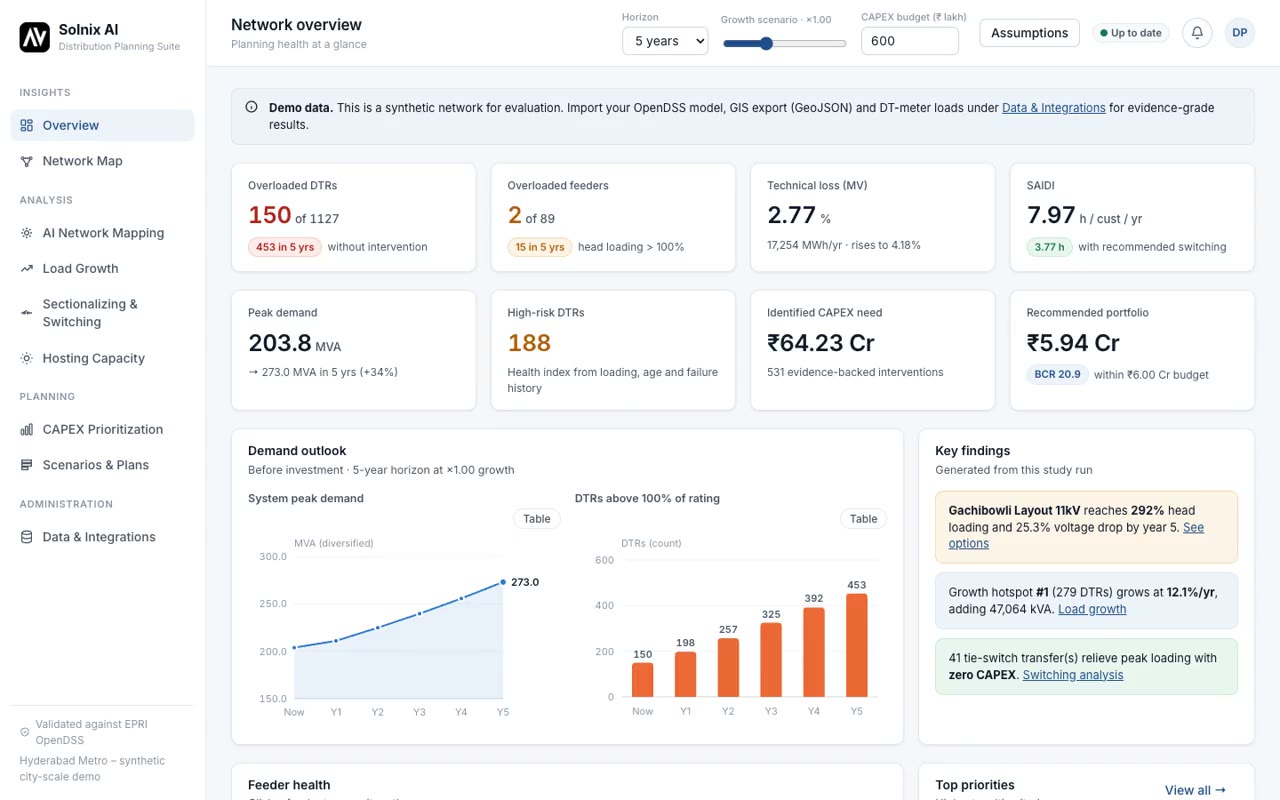
Network mapping, per-transformer load forecasting, reliability, hosting capacity and a budget-constrained capex plan for power utilities.
Abstract
AI Feeder is the distribution network planner Solnix built for power utilities. It maps the medium-voltage feeder network, forecasts load growth for every distribution transformer and feeder, analyses sectionalizing, load switching and hosting capacity, and ranks capital works into a phased plan that fits the budget, with a written justification for each item. Its load flow is cross-validated against EPRI OpenDSS to within 0.0016 per unit.
Key findings
01Load flow is cross-validated against EPRI OpenDSS to within 0.0016 per unit, and the check runs in continuous integration.
02Load is forecast per distribution transformer with P50 and P90 peaks, growth rate and time to overload.
03A budget-constrained optimiser phases transformer, bifurcation and reconductoring works by year, with a justification per item.
04AI Feeder reads and writes OpenDSS and GeoJSON, so it works alongside established power-system analysis suites rather than replacing them.
The AI Feeder planning pipeline.
Inside this paper
From asset data to a mapped network
Connectivity is rebuilt from asset coordinates with a confidence score per span; low-confidence spans are flagged for survey.
Load flow you can verify
A backward/forward sweep at each feeder's real voltage, cross-checked against OpenDSS on every build.
How it compares
Set against CYME, PSS SINCAL, Synergi Electric and OpenDSS by what each is built for.
The full paper, as 3 documents
Part 1Network mapping and load forecastingRebuilding the network from the data you have, and forecasting every transformer.5 pp
Part 2Load flow, reliability and hosting capacityHow the numbers are checked, and what the network can take.3 pp
Part 3Capex planning, agents, track record and comparisonTurning analysis into a fundable plan, and how AI Feeder sits next to established tools.3 pp
EnergyUtilitiesLoad flowCapex planning
+
ProductOctober 2026· 2 documents · 7 pages
Drone Ops: Track Every Object, Flag Only What Matters
Multi-object detection and tracking on live aerial feeds, with rule breaches turned into agent checks and approvals.
Abstract
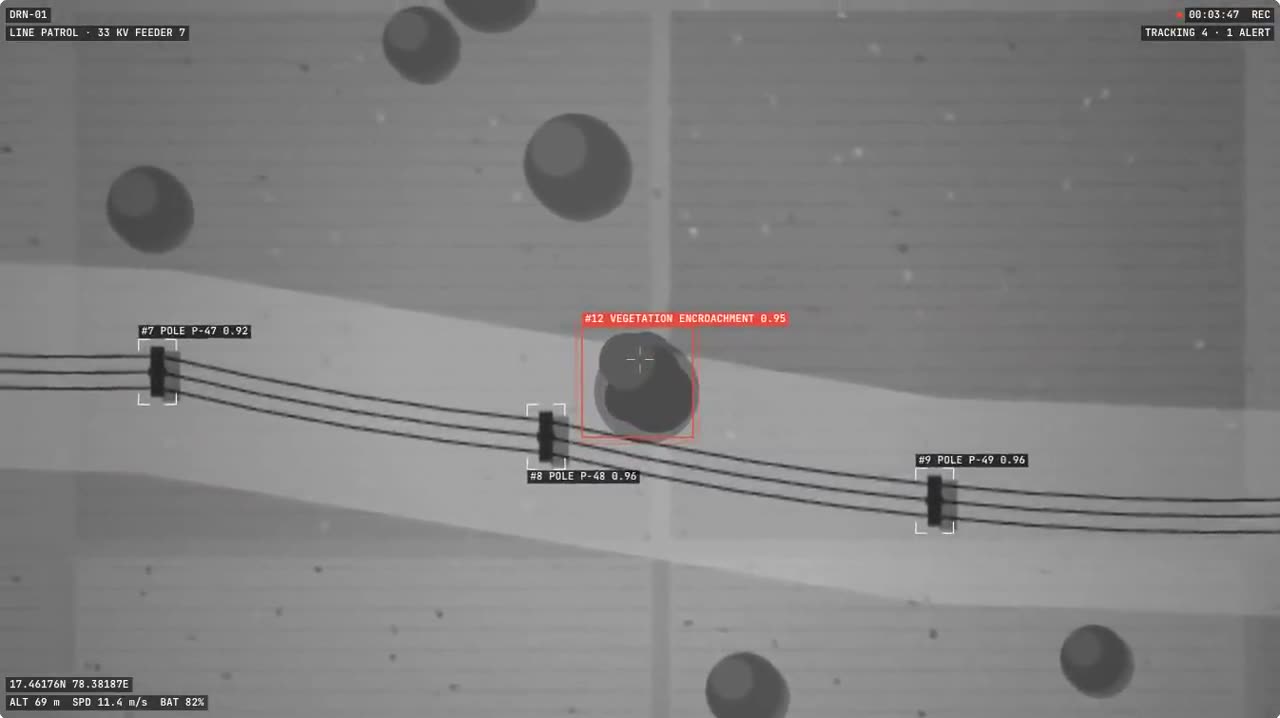
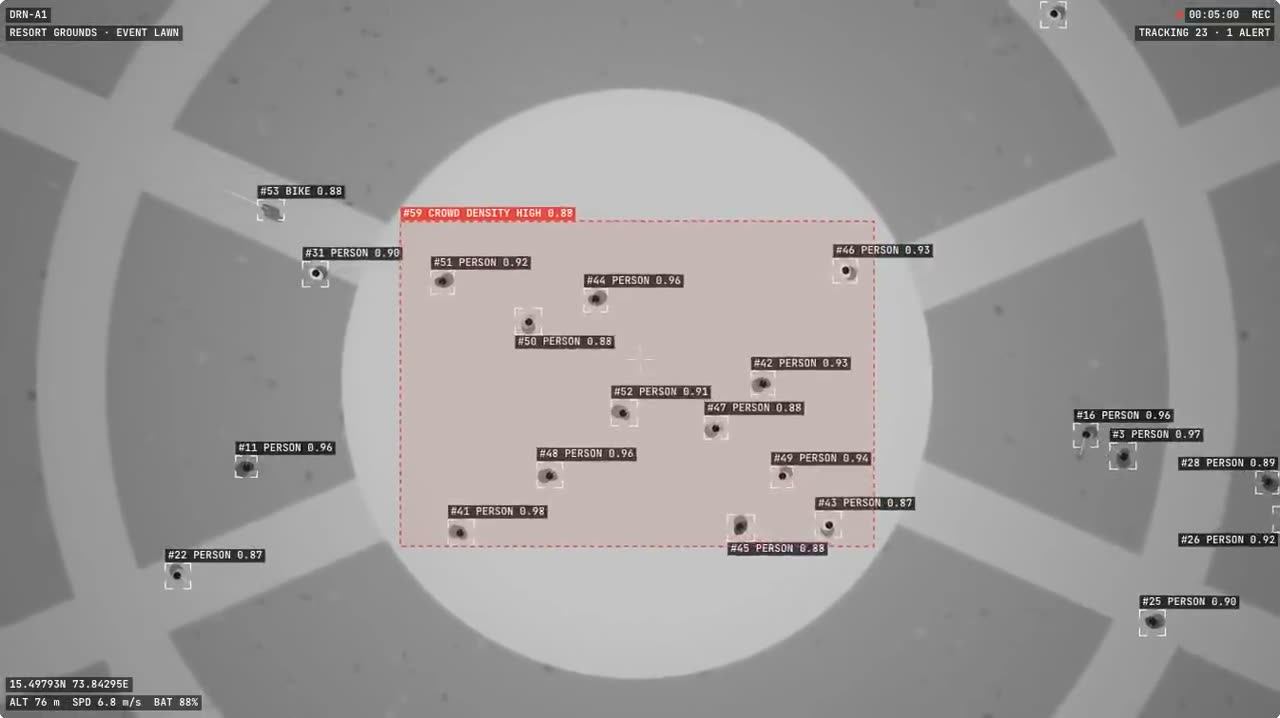
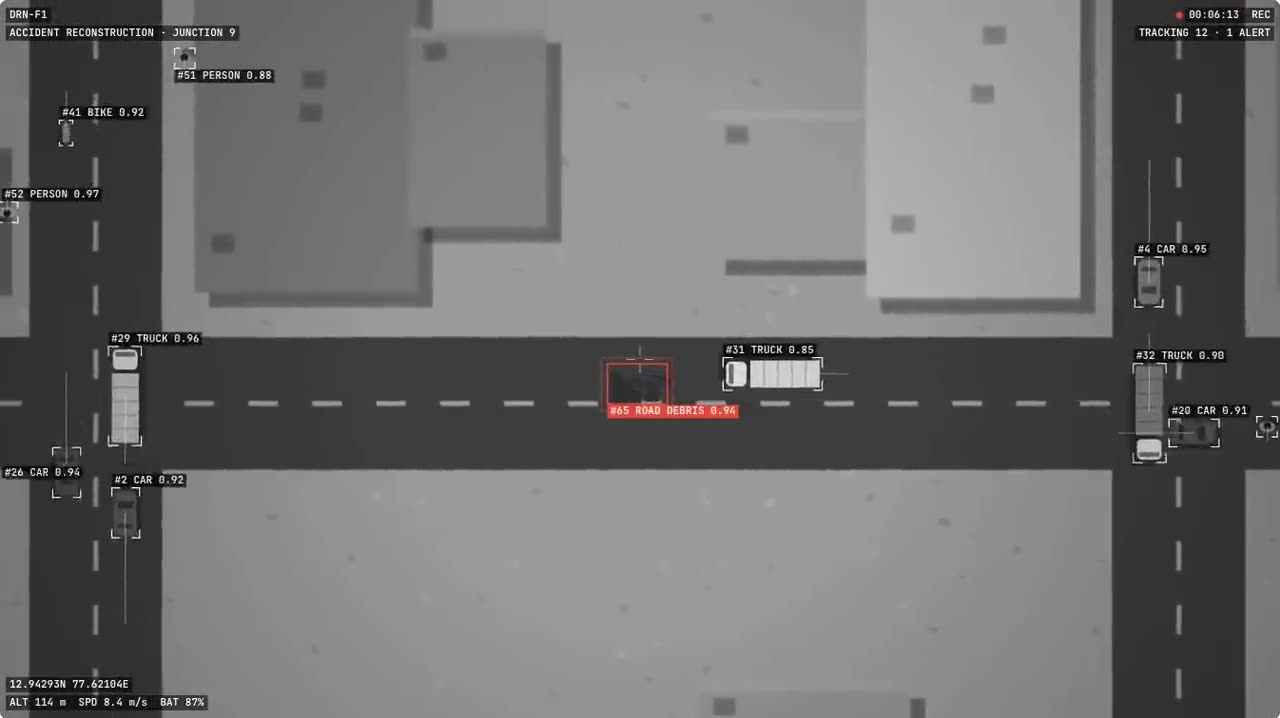
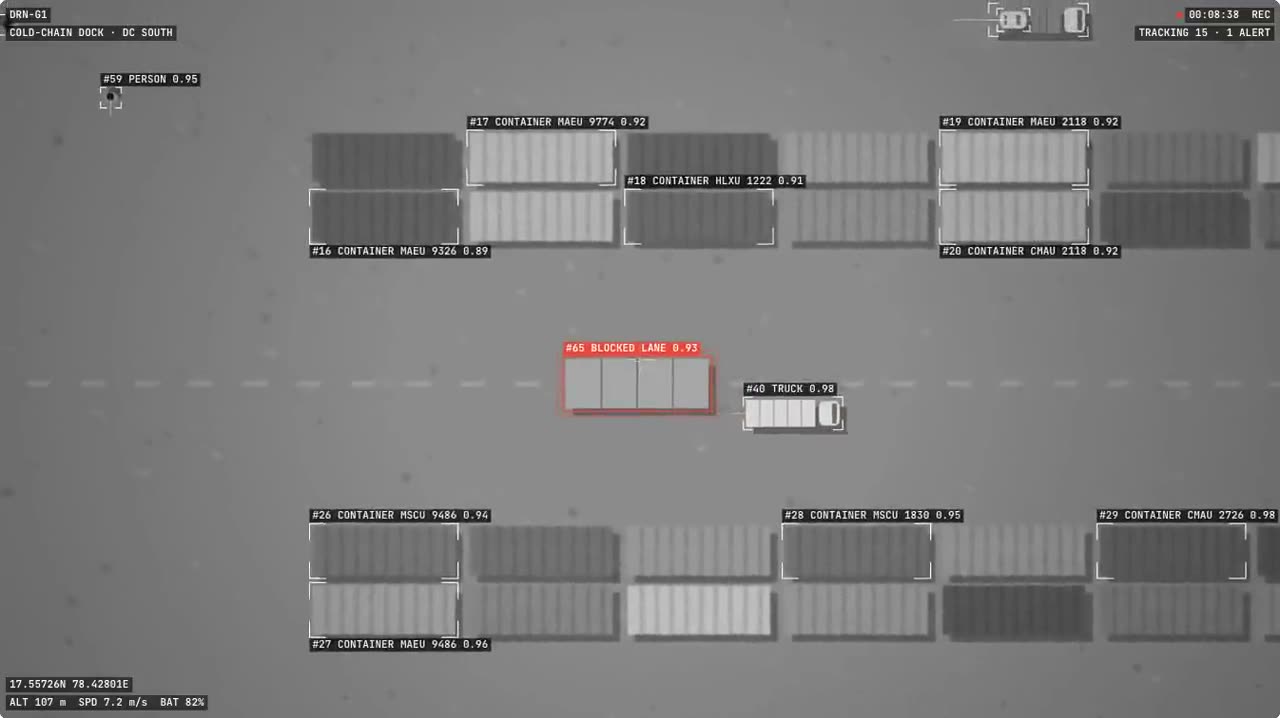
Drone ops is the aerial part of every Solnix Enterprise suite. Each feed detects every object in view, keeps the same ID on each one as it moves, and raises an alert only when something breaks a rule you set. Alerts go into the same agent queue and approvals flow as the rest of the suite, so a red box becomes a drafted work order that the right person approves.
Key findings
01Detection finds every object; tracking keeps a persistent ID on each; rules decide what becomes an alert.
02Each alert opens an agent check with the frame, track history and asset record, and lands in Approvals.
03Missions are written per industry, from line patrol and apron sweeps to hard-hat checks and tower audits.
04Drone platforms capture and map; Drone ops connects what the camera sees to the decision workflow.
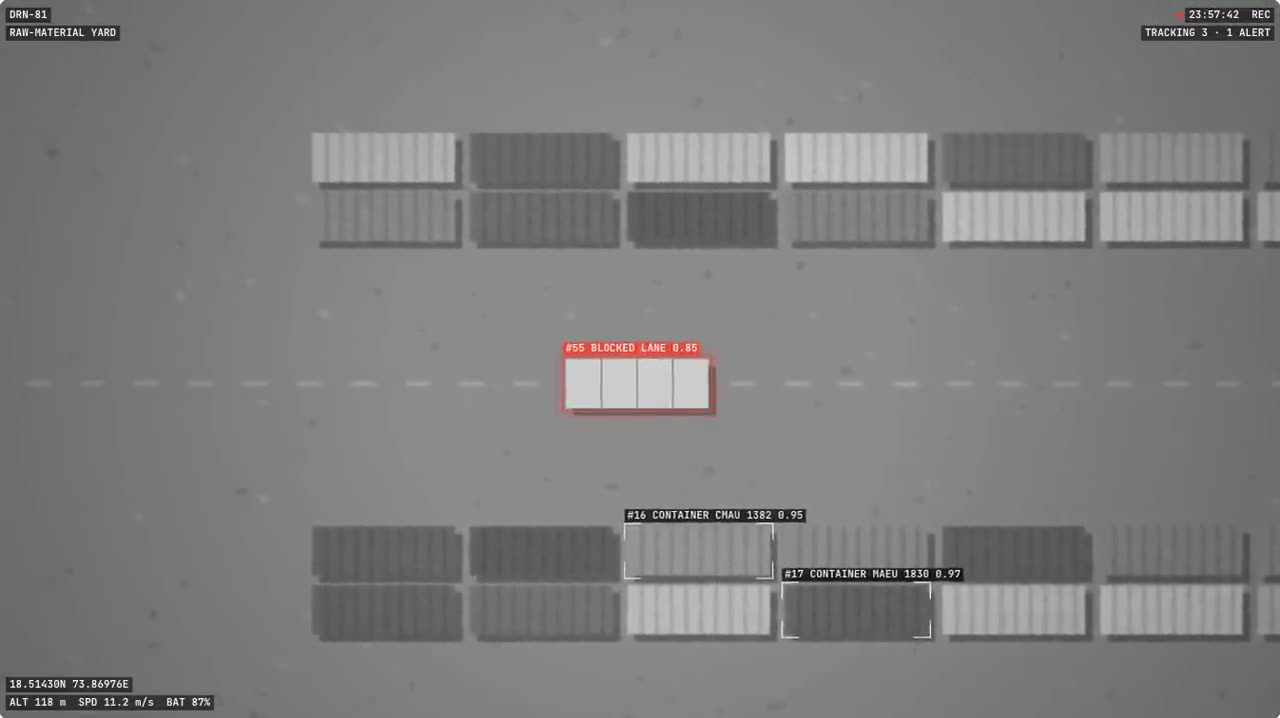
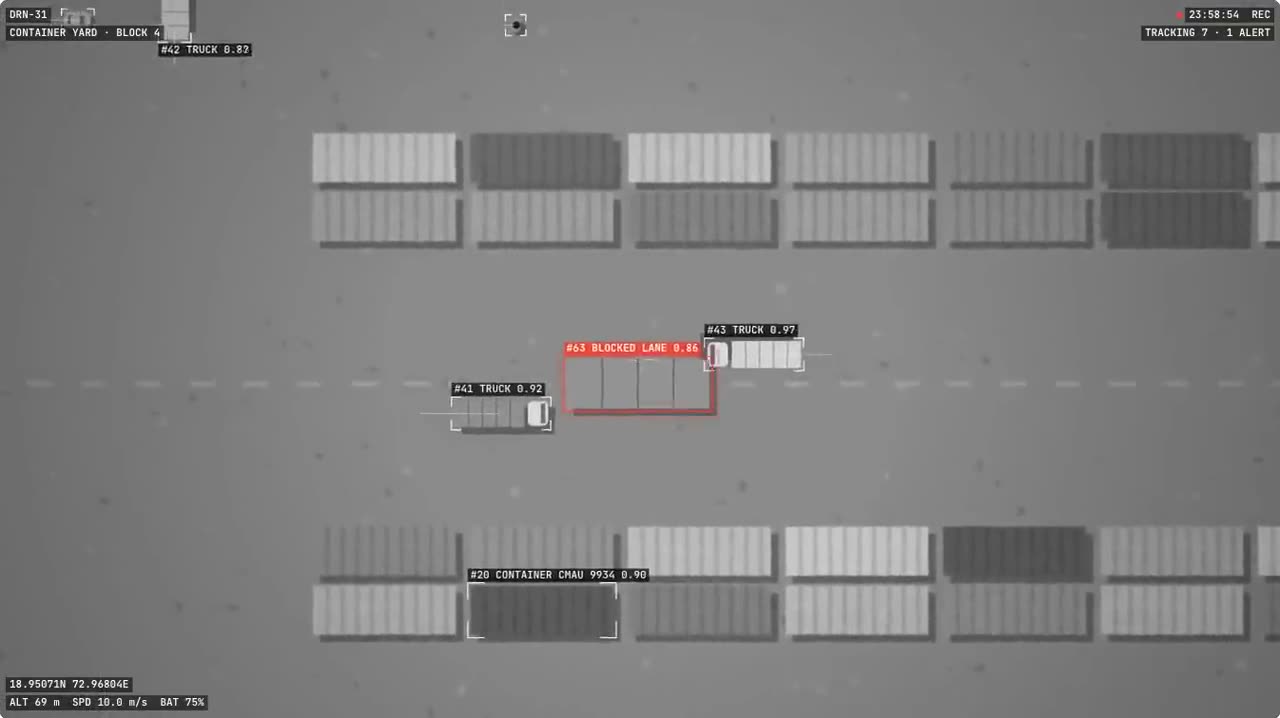
From a frame to an approved action.
Inside this paper
Detection, tracking and the alert rule
Objects that pass a check are green, alerts red, and everything else is simply tracked.
From an alert to a decision
An agent drafts the action, such as a vegetation work order, and the owner approves it.
How it compares
Set against DroneDeploy, Skydio and fixed-camera video analytics.
The full paper, as 2 documents
Part 1How Drone ops worksDetection, tracking, rules and the missions for each industry.4 pp
Part 2Operations, track record and comparisonFrom alert to decision, four feeds at once, and how it compares.3 pp
DronesComputer visionInspectionSafety
+
ProductOctober 2026· 2 documents · 7 pages
AI CAD: From a Written Brief to a Checked, Dimensioned Design
A design agent generates parametric geometry and variants, checking agents test them, and an engineer signs off.
Abstract
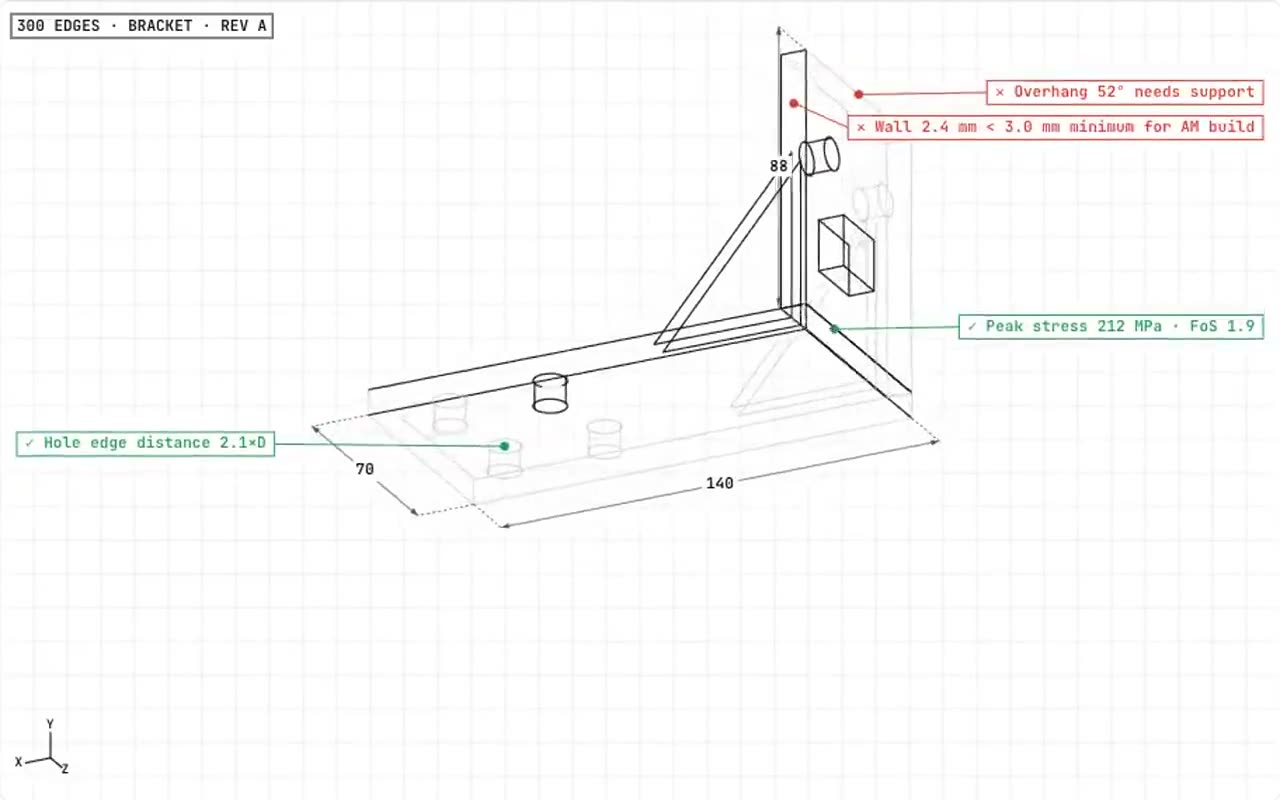
AI CAD turns a short written brief into parametric geometry, dimensions and a drawing sheet, then has agents check the design against codes, clashes and loads before an engineer signs off. Every Solnix Enterprise suite has a design for its industry, from an engine mount bracket to a 40 m lattice tower. AI CAD shortens the path to a reviewable first draft; it never releases a design on its own.
Key findings
01The input is a sentence an engineer would write anyway; the output is parametric geometry, not a picture.
02Each brief produces several variants with their key figure, such as mass or capacity, side by side.
03Checking agents mark passes in green and issues in red, and send each issue back with a fix.
04Exports cover STEP, IFC, DXF and PDF, so the design continues in your existing CAD and BIM tools.
The AI CAD loop: issues return to the design agent until checks pass.
Inside this paper
Variants, not a single answer
Variants trade off differently so the engineer chooses where to start.
Checks before review
Wall thickness, overhangs, clashes, utilisation and code checks run on every variant.
How it compares
Set against Autodesk Fusion generative design, nTop and Siemens NX.
The full paper, as 2 documents
Part 1From brief to variantsHow a written brief becomes parametric geometry and design options.4 pp
Part 2Checks, drawings, track record and comparisonWhat gets checked, what comes out, and how AI CAD sits next to CAD tools.3 pp
AI CADEngineeringGenerative designDesign checks
+
ProductOctober 2026· 2 documents · 7 pages
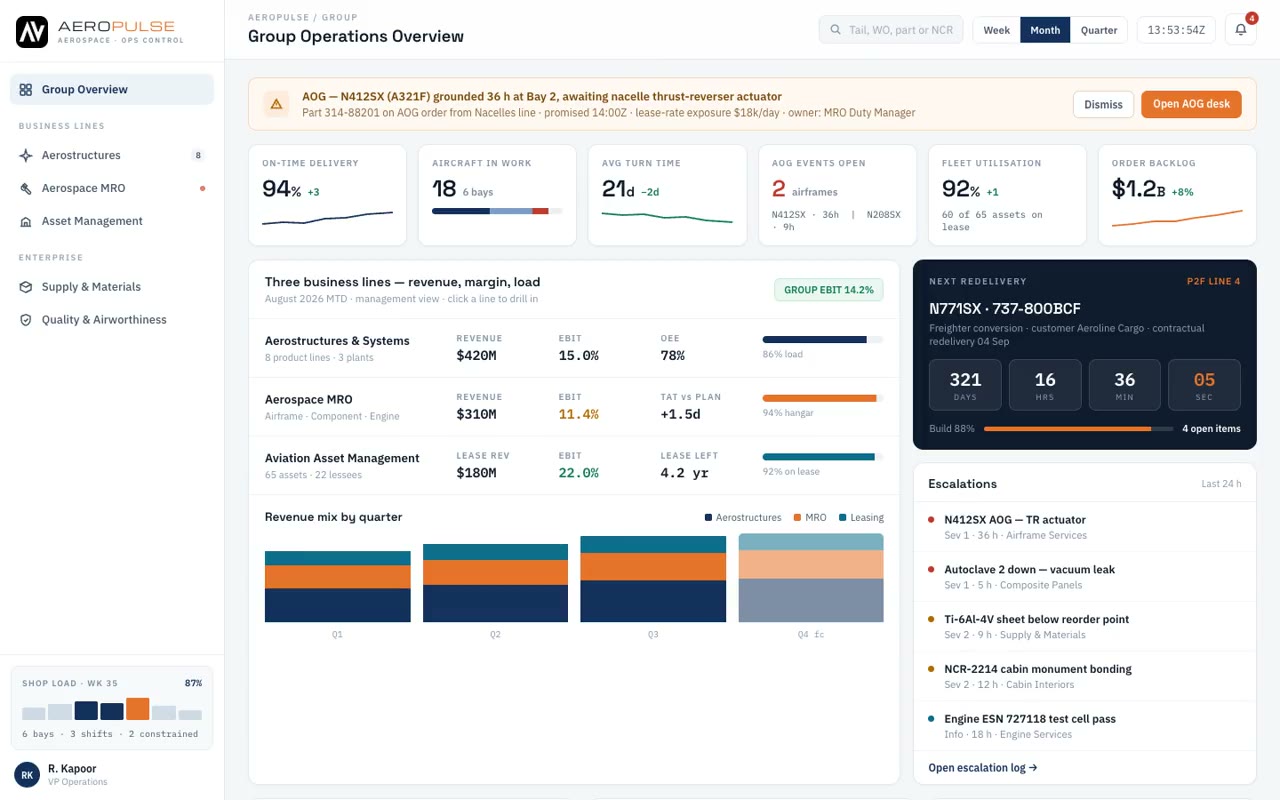
AeroPulse: One Operations View for an Aerospace Group
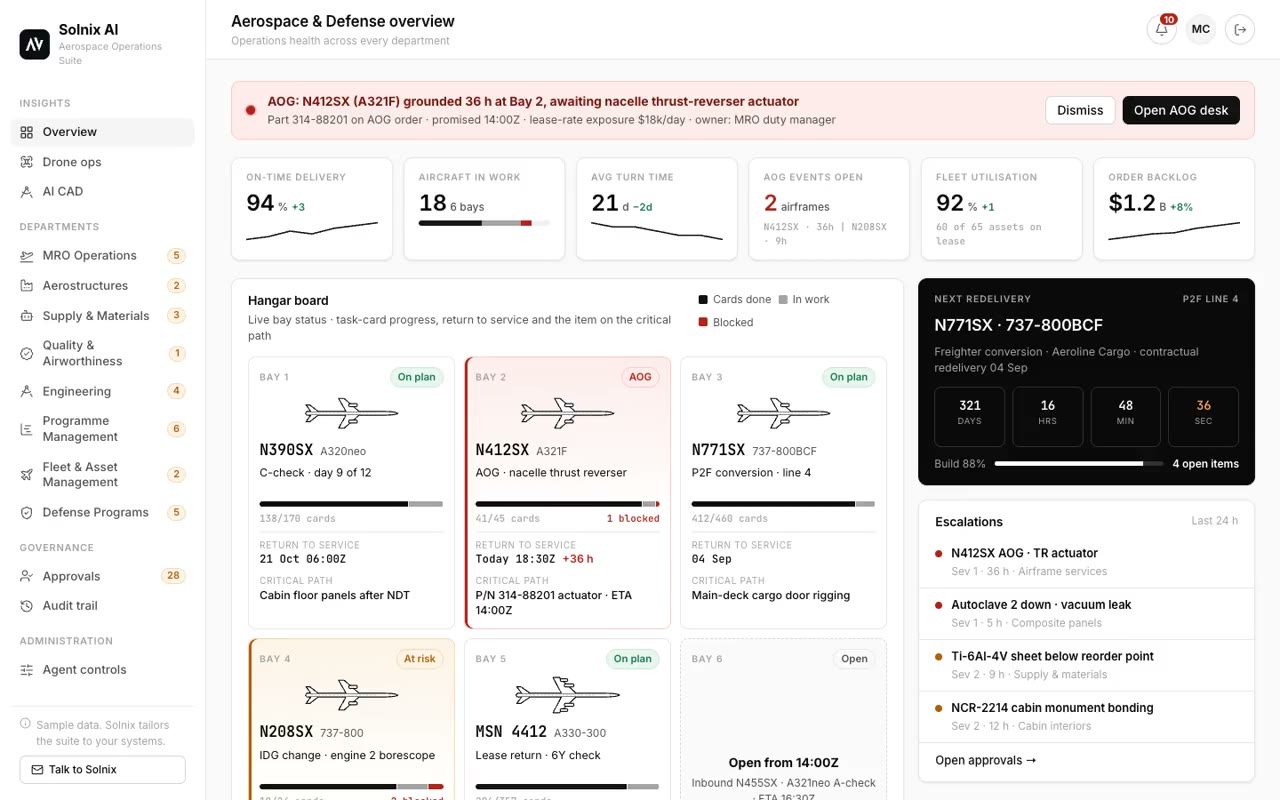
Aerostructures, MRO and leasing on one leadership screen: the AOG that matters now, the next redelivery and what is escalating.
Abstract
AeroPulse is an operations control dashboard Solnix designed for an aerospace group that runs three businesses: aerostructures, aircraft maintenance (MRO) and aviation asset leasing. It puts what operations leadership needs every morning on one screen, on top of the maintenance and ERP systems the group already runs. Figures in the demo are illustrative.
Key findings
01The page leads with the active AOG event: airframe, awaited part, promised time, lease-rate exposure per day and owner.
02Each business line has a row with the measures it is run on, plus a revenue mix by quarter.
03A countdown tracks the next contractual redelivery with build progress and open items.
04AeroPulse is a leadership view that reads from systems of record such as AMOS, TRAX or Ramco; it does not replace them.
Layout of the AeroPulse screen.
Inside this paper
The AOG that matters right now
One click opens the AOG desk.
Three business lines side by side
Line-specific measures such as turnaround against plan for MRO and remaining lease term for leasing.
How it compares
Set against MRO systems of record: Swiss-AS AMOS, TRAX, Ramco Aviation and IFS.
The full paper, as 2 documents
Part 1The leadership screenWhat AeroPulse shows and why.4 pp
Part 2Track record and comparisonWhere AeroPulse fits next to MRO systems.3 pp
AerospaceMROOperationsDashboards
+
ProductOctober 2026· 2 documents · 6 pages
MCP Servers: Connecting AI Apps to the Systems You Run
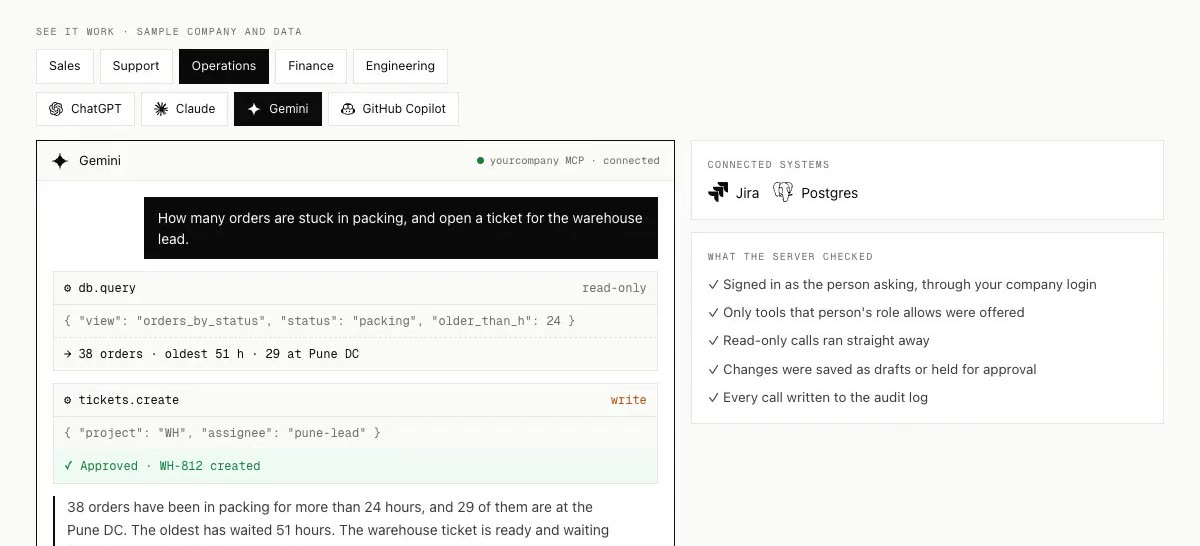
One secure server lets ChatGPT, Claude, Gemini, Copilot and Cursor look things up and take actions in your CRM, database and tools, under your rules.
Abstract
The Model Context Protocol is an open standard, introduced by Anthropic in November 2024, for connecting AI apps to tools and data. One MCP server works across ChatGPT, Claude, Gemini, GitHub Copilot, Cursor and other compatible apps. Solnix designs, builds, secures and hosts MCP servers with company sign-in, role-scoped tools, approval on writes and an audit log.
Key findings
01One MCP server, built once, works across every MCP-compatible AI app your people use.
02People sign in with their company account; each sees only the tools their role allows.
03Read-only calls run straight away; changes are drafted or held for approval, and every call is logged.
04Hosted connector catalogues are quick to start; a custom server is for your own systems and rules.
One server between many AI apps and your systems.
Inside this paper
What an MCP server is
A secure adaptor between the AI apps your staff use and the software your business runs on.
Security and control
Company sign-in, role-scoped tools, approval on writes, injection guards and an audit log.
How it compares
Set against Zapier MCP, Composio, vendor-published servers and building it yourself.
The full paper, as 2 documents
Part 1What MCP is and what teams use it forThe standard, the architecture and the use cases by team.3 pp
Part 2Security, delivery, track record and comparisonThe control layers, how a project runs and the alternatives.3 pp
MCPIntegrationSecurityAI apps
+
ProductOctober 2026· 3 documents · 8 pages
Growth in the AI Era: Agentic Websites, AI Search Visibility and AI Chat Ads
Three services for being found, answering and converting buyers who now ask AI assistants before they buy.
Abstract
Buyers increasingly research suppliers by asking AI assistants, then arrive on a website expecting an answer rather than a form. This paper covers the three Solnix growth services: an agentic website whose built-in agent answers, qualifies and books calls; AI search visibility, which finds and fixes how assistants describe your brand; and AI chat ads, which set up and manage ads inside assistants that offer them. Solnix runs the same approach on solnixmedia.com with Solnix Chat.
Key findings
01An agentic website answers from your own content, qualifies against your rules, books calls and writes to your CRM.
02AI search visibility starts with a baseline of what each assistant says about you and which sources it relies on.
03Nobody can guarantee what an assistant will say; you can make accurate information easy to find and track the change monthly.
04AI chat ads start with eligibility and conversion tracking before any spend.
The monthly visibility cycle.
Inside this paper
Agentic websites
A site with a built-in agent that hands off to a person whenever asked.
AI search visibility
Baseline audit, fix plan, fixes and monthly tracking.
AI chat ads
Eligibility, tracking, ads, launch on approval and monthly reporting.
The full paper, as 3 documents
Part 1Agentic websitesA website that answers, qualifies and books.3 pp
Part 2AI search visibilityHow assistants describe your brand, and how to fix it.2 pp
Part 3AI chat ads, track record and comparisonAdvertising inside assistants, and how the three services compare with alternatives.3 pp
Agentic websitesAI searchAEOAI chat ads
+
IndustryOctober 2026· 5 documents · 36 pages
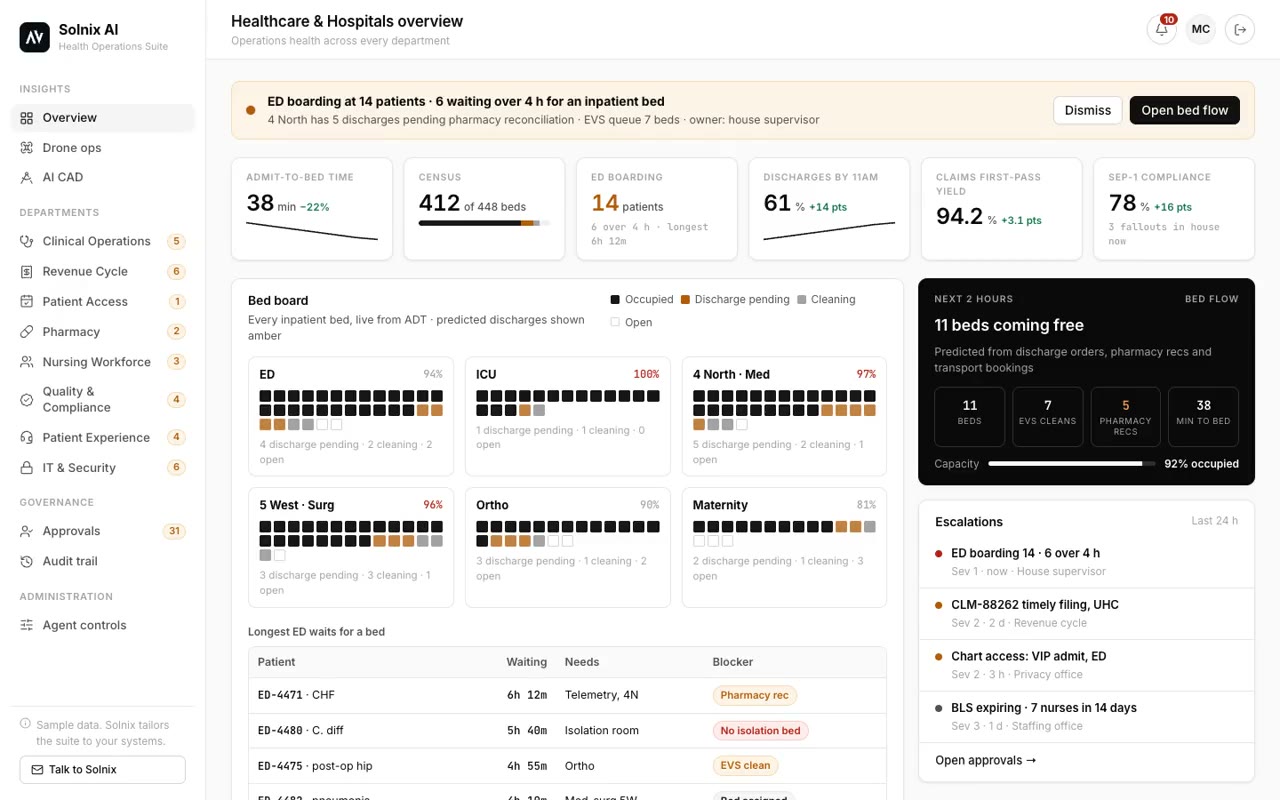
Healthcare & Hospitals: The Solnix Agent Suite in Depth
Domain context, regulation, and a full playbook for each of the 8 departments: agents, checkpoints, measures, systems and a pilot plan.
Abstract
A hospital runs as a set of tightly coupled queues. An emergency department patient who needs admission waits for a bed; the bed waits for a discharge, a clean and a transport; the discharge waits for a physician order, a pharmacy reconciliation and sometimes a payer authorisation for the next level of care. Delay in any one queue shows up as ED boarding, cancelled elective cases and staff overtime somewhere else. This paper sets out the regulation and systems that shape the work, then walks through each of the 8 departments in the Solnix Healthcare & Hospitals suite: what makes the work hard, what each agent does, who decides, what the dashboard tracks and how to pilot it. It closes with Drone ops, AI CAD, approvals, deployment and a comparison with the platforms health teams already use.
Key findings
018 department playbooks, each with its trigger, agent steps, named checkpoint, dashboard measures and connected systems.
02Designed around HIPAA Privacy and Security Rules and CMS Interoperability and Prior Authorization Final Rule (CMS-0057-F), among others.
03Decisions reserved for people stop in Approvals with every agent's evidence; every run is in the audit trail.
04Works alongside Epic (and other EHR vendors' AI features) and Qventus rather than replacing them.
The 8 departments of the Healthcare & Hospitals suite and the workflow each one runs.
Inside this paper
Industry context and regulation
Capacity: ED boarding and bed turnaround drive patient safety, staff burnout and lost surgical volume. Revenue integrity: payer rules change constantly, and every denial costs rework and delays cash.
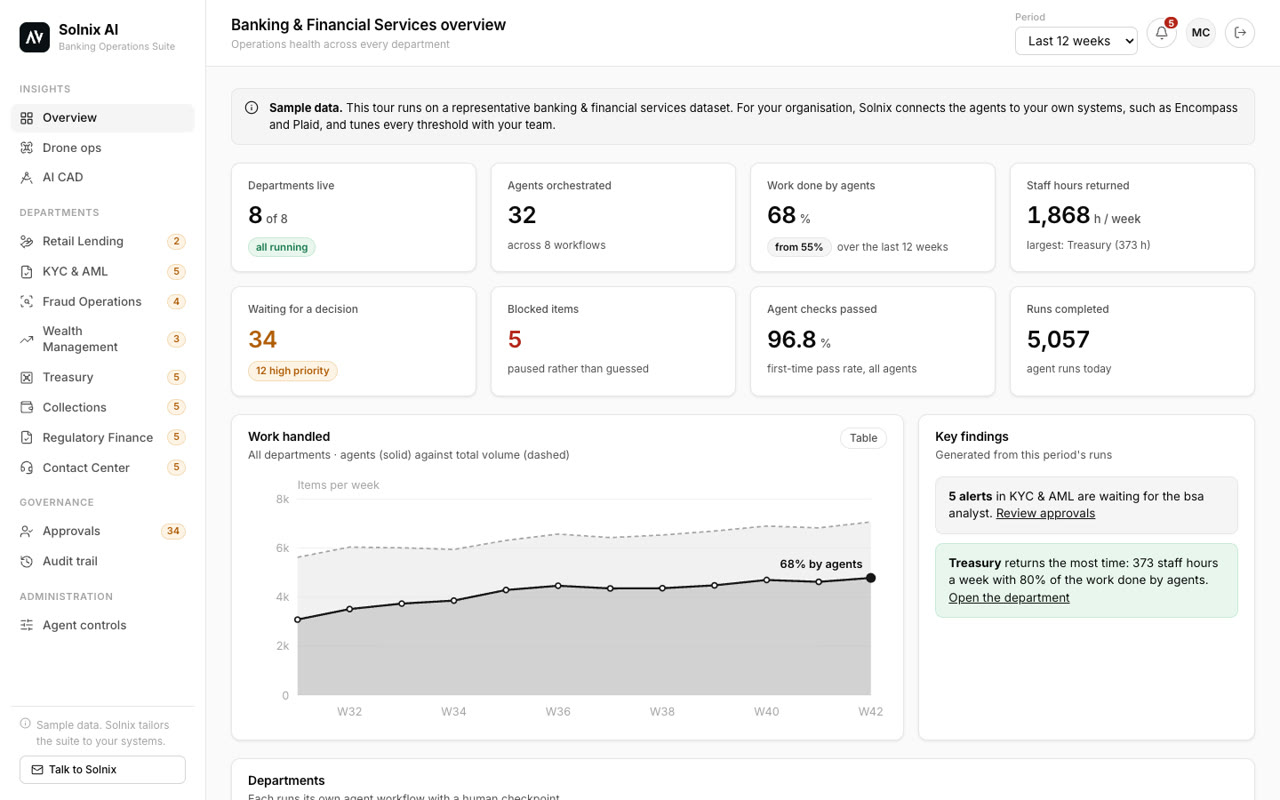
Banking & Financial Services: The Solnix Agent Suite in Depth
Domain context, regulation, and a full playbook for each of the 8 departments: agents, checkpoints, measures, systems and a pilot plan.
Abstract
A bank's operations are a chain of regulated decisions: whether to lend, whether an alert is suspicious, whether a transaction is fraud, whether a complaint is resolved fairly. Each decision rests on documents and data spread across the core banking platform, loan origination system, case managers and credit bureaus, and each must be explainable to examiners afterwards. This paper sets out the regulation and systems that shape the work, then walks through each of the 8 departments in the Solnix Banking & Financial Services suite: what makes the work hard, what each agent does, who decides, what the dashboard tracks and how to pilot it. It closes with Drone ops, AI CAD, approvals, deployment and a comparison with the platforms banking teams already use.
Key findings
018 department playbooks, each with its trigger, agent steps, named checkpoint, dashboard measures and connected systems.
02Designed around Bank Secrecy Act and FinCEN SAR rules and OFAC sanctions, among others.
03Decisions reserved for people stop in Approvals with every agent's evidence; every run is in the audit trail.
04Works alongside nCino and NICE Actimize rather than replacing them.
The 8 departments of the Banking & Financial Services suite and the workflow each one runs.
Inside this paper
Industry context and regulation
Financial crime: alert volumes from transaction monitoring and sanctions screening outpace analyst capacity. Real-time payments: instant rails shorten the window to stop fraud from minutes to seconds.
Domain context, regulation, and a full playbook for each of the 8 departments: agents, checkpoints, measures, systems and a pilot plan.
Abstract
An insurer earns its margin in underwriting and loses it in claims leakage, expense and slow service. Underwriters triage broker submissions that arrive as emails, PDFs and spreadsheets; claims handlers gather photos, estimates and coverage facts; actuaries rebuild triangles from data that arrives late; compliance files rates and forms state by state. This paper sets out the regulation and systems that shape the work, then walks through each of the 8 departments in the Solnix Insurance suite: what makes the work hard, what each agent does, who decides, what the dashboard tracks and how to pilot it. It closes with Drone ops, AI CAD, approvals, deployment and a comparison with the platforms insurance teams already use.
Key findings
018 department playbooks, each with its trigger, agent steps, named checkpoint, dashboard measures and connected systems.
02Designed around NAIC Model Bulletin on the Use of AI Systems by Insurers and State rate and form filing (SERFF), among others.
03Decisions reserved for people stop in Approvals with every agent's evidence; every run is in the audit trail.
04Works alongside Guidewire and Duck Creek rather than replacing them.
The 8 departments of the Insurance suite and the workflow each one runs.
Inside this paper
Industry context and regulation
Submission volume: commercial submissions arrive unstructured and need triage before an underwriter looks. Claims cycle time and leakage: faster, accurate settlement improves retention and cost.
Department playbooks
Underwriting (Commercial Submission Intake), Claims (FNOL to Payment), Special Investigations (SIU Referral Engine), Policy Servicing (Endorsement Desk), Actuarial (Reserving Analyst), Distribution (Agency Growth Desk), Compliance (Rate & Form Filing), Finance (Reinsurance Recoveries).
Deployment and comparison
Insurers buy AI through core platforms, specialist claims and fraud vendors, or build in-house.
The full paper, as 5 documents
Part 1Insurance operations and the suiteThe industry's operating reality, regulation, systems and how the suite maps to its departments.5 pp
Part 2Department playbooks, part 1Underwriting, Claims, Special Investigations, Policy Servicing12 pp
Part 3Department playbooks, part 2Actuarial, Distribution, Compliance, Finance12 pp
Part 4Drone ops, AI CAD, approvals and CopilotWhat the Insurance suite does in the field and on the drawing board, and how people stay in charge.5 pp
Part 5Deployment, track record and comparisonHow a insurance deployment runs, what Solnix has built, and the alternatives.3 pp
Retail & E-commerce: The Solnix Agent Suite in Depth
Domain context, regulation, and a full playbook for each of the 8 departments: agents, checkpoints, measures, systems and a pilot plan.
Abstract
Retail runs on many small decisions made daily across thousands of SKUs and stores: what to reorder, what to mark down, what to show which customer, how to answer where an order is. Margins are thin, so each decision needs to be right often, not occasionally. This paper sets out the regulation and systems that shape the work, then walks through each of the 8 departments in the Solnix Retail & E-commerce suite: what makes the work hard, what each agent does, who decides, what the dashboard tracks and how to pilot it. It closes with Drone ops, AI CAD, approvals, deployment and a comparison with the platforms retail teams already use.
Key findings
018 department playbooks, each with its trigger, agent steps, named checkpoint, dashboard measures and connected systems.
02Designed around PCI DSS and GDPR / CCPA and similar privacy laws, among others.
03Decisions reserved for people stop in Approvals with every agent's evidence; every run is in the audit trail.
04Works alongside Blue Yonder and RELEX Solutions rather than replacing them.
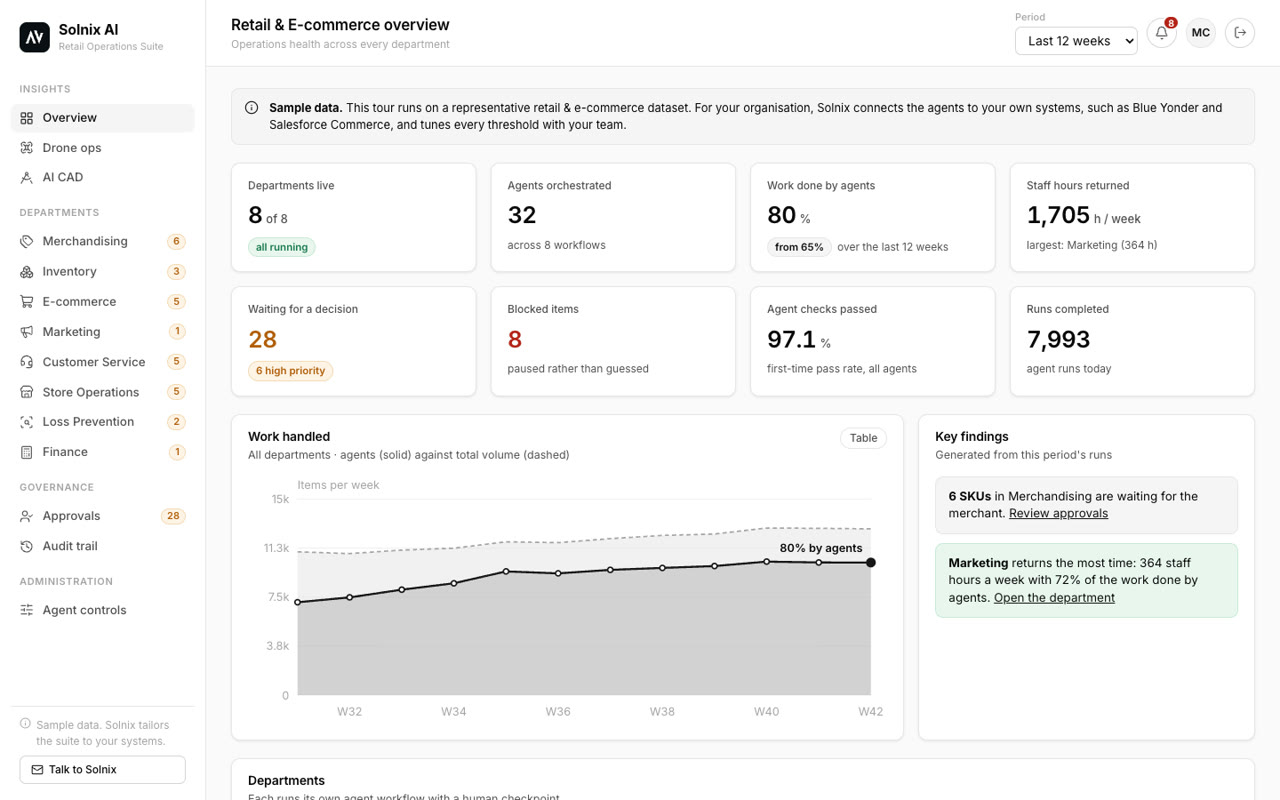
The 8 departments of the Retail & E-commerce suite and the workflow each one runs.
Inside this paper
Industry context and regulation
Inventory: too much stock means markdowns, too little means lost sales. Pricing: competitors change prices constantly and markdown timing decides margin.
Domain context, regulation, and a full playbook for each of the 8 departments: agents, checkpoints, measures, systems and a pilot plan.
Abstract
A plant's performance depends on how well schedule, quality, maintenance and supply stay in step. A resin shortage changes the schedule; a drifting process changes quality; a bearing about to fail changes both. Each function has its own system (ERP, MES, CMMS, QMS, PLM) and the coordination between them is often meetings and spreadsheets. This paper sets out the regulation and systems that shape the work, then walks through each of the 8 departments in the Solnix Manufacturing suite: what makes the work hard, what each agent does, who decides, what the dashboard tracks and how to pilot it. It closes with Drone ops, AI CAD, approvals, deployment and a comparison with the platforms mfg teams already use.
Key findings
018 department playbooks, each with its trigger, agent steps, named checkpoint, dashboard measures and connected systems.
02Designed around ISO 9001 and sector standards such as IATF 16949 or AS9100 and ISO 45001 and OSHA recordkeeping (29 CFR 1904), among others.
03Decisions reserved for people stop in Approvals with every agent's evidence; every run is in the audit trail.
04Works alongside SAP (S/4HANA, IBP) and Siemens Opcenter rather than replacing them.
The 8 departments of the Manufacturing suite and the workflow each one runs.
Inside this paper
Industry context and regulation
Schedule stability: material shortages and rush orders force re-sequencing several times a day. Quality: process drift must be caught before scrap or escapes reach customers.
Logistics & Supply Chain: The Solnix Agent Suite in Depth
Domain context, regulation, and a full playbook for each of the 8 departments: agents, checkpoints, measures, systems and a pilot plan.
Abstract
Logistics margins depend on utilisation and exceptions. A route plan is only as good as its response to traffic, driver hours and a new two-hour medical delivery; a warehouse wave only works if labour and trailers line up; an invoice audit only saves money if every accessorial charge is checked against contract. This paper sets out the regulation and systems that shape the work, then walks through each of the 8 departments in the Solnix Logistics & Supply Chain suite: what makes the work hard, what each agent does, who decides, what the dashboard tracks and how to pilot it. It closes with Drone ops, AI CAD, approvals, deployment and a comparison with the platforms logistics teams already use.
Key findings
018 department playbooks, each with its trigger, agent steps, named checkpoint, dashboard measures and connected systems.
02Designed around FMCSA Hours of Service and ELD rules and Driver vehicle inspection reports (49 CFR 396.11), among others.
03Decisions reserved for people stop in Approvals with every agent's evidence; every run is in the audit trail.
04Works alongside project44 / FourKites and Descartes rather than replacing them.
The 8 departments of the Logistics & Supply Chain suite and the workflow each one runs.
Inside this paper
Industry context and regulation
Delivery promises are tighter while traffic and capacity vary through the day. Warehouse labour is the largest cost and the hardest to flex.
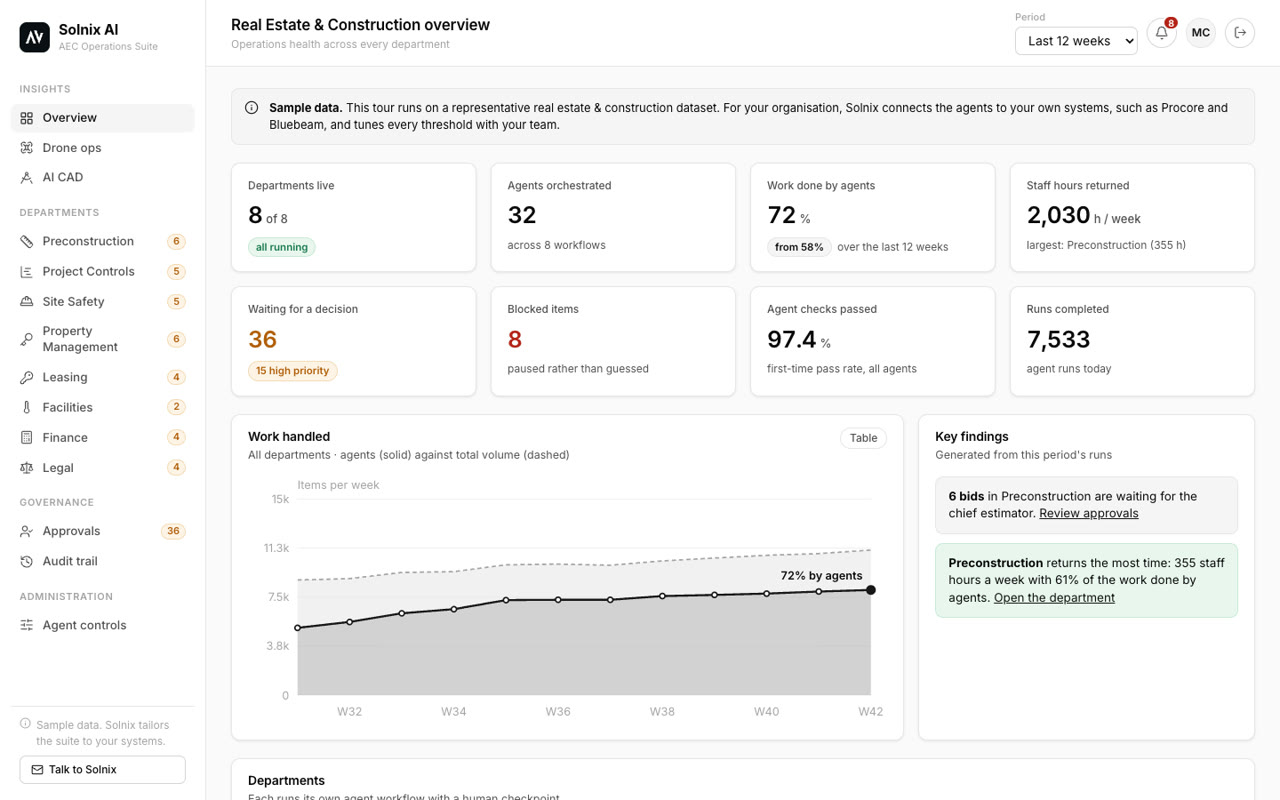
Real Estate & Construction: The Solnix Agent Suite in Depth
Domain context, regulation, and a full playbook for each of the 8 departments: agents, checkpoints, measures, systems and a pilot plan.
Abstract
Real estate and construction connect two very different operations. Construction turns drawings into buildings through bids, RFIs, submittals, site safety and monthly pay applications. Property operations keep buildings leased, maintained and efficient once they stand. Both run on documents: drawings, specifications, contracts, leases and invoices. This paper sets out the regulation and systems that shape the work, then walks through each of the 8 departments in the Solnix Real Estate & Construction suite: what makes the work hard, what each agent does, who decides, what the dashboard tracks and how to pilot it. It closes with Drone ops, AI CAD, approvals, deployment and a comparison with the platforms aec teams already use.
Key findings
018 department playbooks, each with its trigger, agent steps, named checkpoint, dashboard measures and connected systems.
02Designed around OSHA construction standards (29 CFR 1926) and AIA G702/G703 payment applications and lien waivers, among others.
03Decisions reserved for people stop in Approvals with every agent's evidence; every run is in the audit trail.
04Works alongside Procore and Autodesk Construction Cloud rather than replacing them.
The 8 departments of the Real Estate & Construction suite and the workflow each one runs.
Inside this paper
Industry context and regulation
Bid accuracy: missed scope in takeoffs becomes change orders or losses. Coordination: RFIs and submittals stall work when they sit unanswered.
Construction and property firms rely on established project and property management platforms.
The full paper, as 5 documents
Part 1AEC operations and the suiteThe industry's operating reality, regulation, systems and how the suite maps to its departments.5 pp
Part 2Department playbooks, part 1Preconstruction, Project Controls, Site Safety, Property Management12 pp
Part 3Department playbooks, part 2Leasing, Facilities, Finance, Legal11 pp
Part 4Drone ops, AI CAD, approvals and CopilotWhat the AEC suite does in the field and on the drawing board, and how people stay in charge.5 pp
Part 5Deployment, track record and comparisonHow a aec deployment runs, what Solnix has built, and the alternatives.3 pp
Real Estate & ConstructionSolnix EnterpriseDepartment playbooksCompetitor comparison
+
IndustryOctober 2026· 5 documents · 35 pages
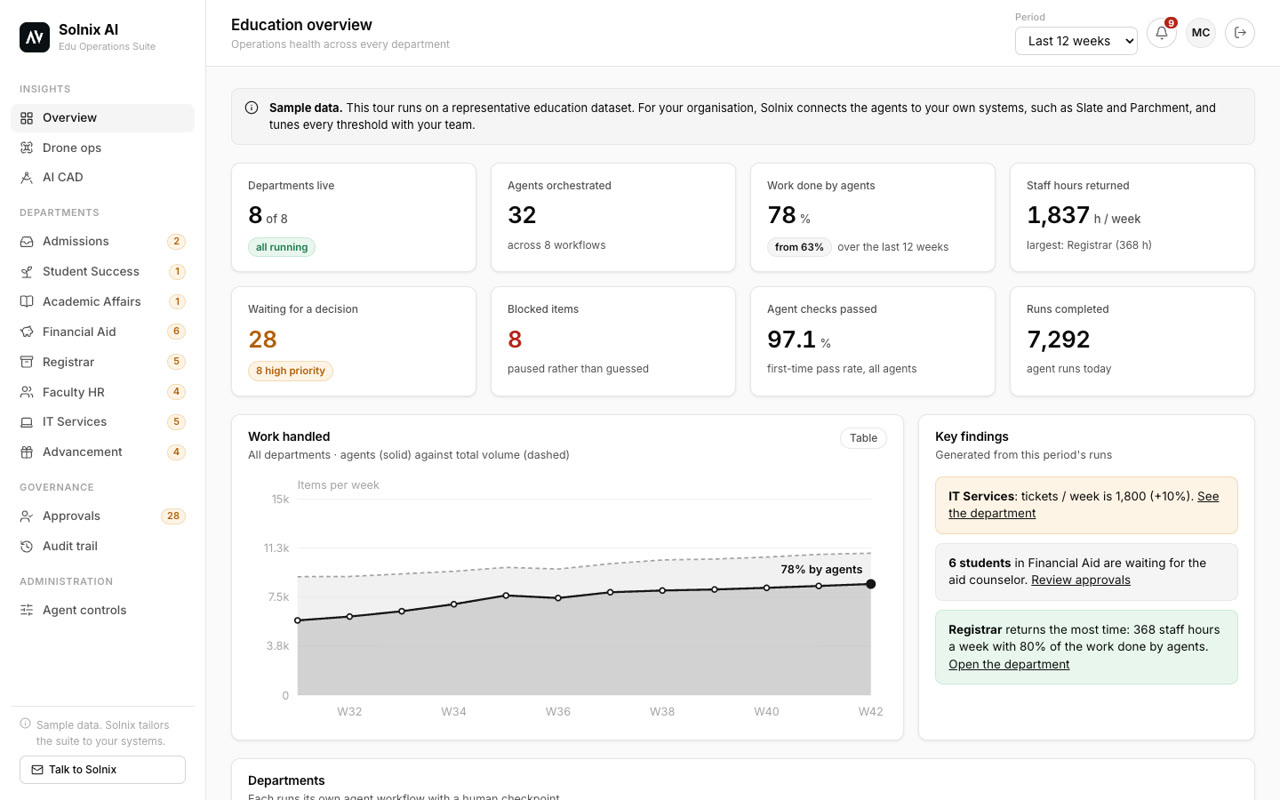
Education: The Solnix Agent Suite in Depth
Domain context, regulation, and a full playbook for each of the 8 departments: agents, checkpoints, measures, systems and a pilot plan.
Abstract
Universities and colleges handle large seasonal peaks of applications, aid verification, transfer evaluations and help desk tickets, with small teams and strict rules on student data. The same student appears in the admissions CRM, the student information system, the learning management system and financial aid systems. This paper sets out the regulation and systems that shape the work, then walks through each of the 8 departments in the Solnix Education suite: what makes the work hard, what each agent does, who decides, what the dashboard tracks and how to pilot it. It closes with Drone ops, AI CAD, approvals, deployment and a comparison with the platforms edu teams already use.
Key findings
018 department playbooks, each with its trigger, agent steps, named checkpoint, dashboard measures and connected systems.
02Designed around FERPA and Title IV of the Higher Education Act, among others.
03Decisions reserved for people stop in Approvals with every agent's evidence; every run is in the audit trail.
04Works alongside Ellucian and Technolutions Slate rather than replacing them.
The 8 departments of the Education suite and the workflow each one runs.
Inside this paper
Industry context and regulation
Enrolment: competition for students makes response time and yield critical. Retention: early warning signs in coursework and finances need timely outreach.
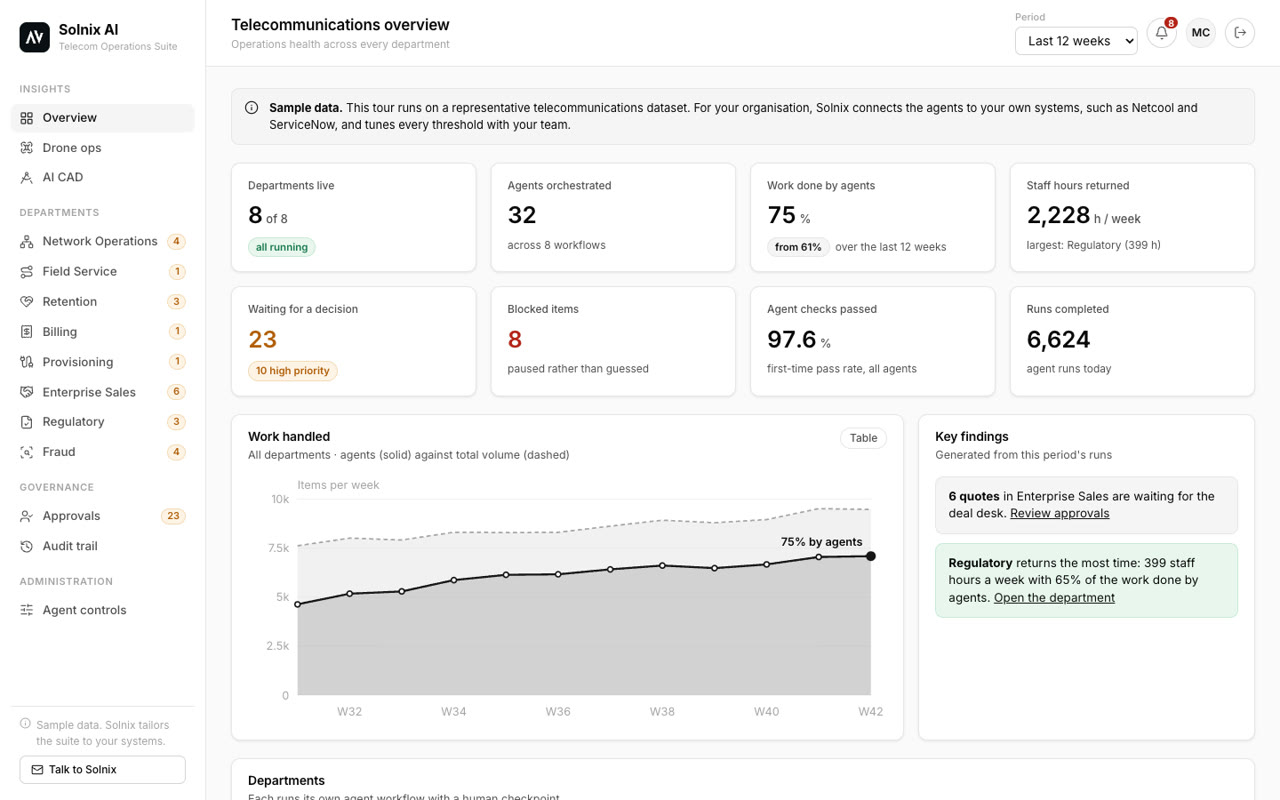
Telecommunications: The Solnix Agent Suite in Depth
Domain context, regulation, and a full playbook for each of the 8 departments: agents, checkpoints, measures, systems and a pilot plan.
Abstract
Telecom operators run networks with many layers (radio, transport, core) and customer operations at very large scale. Incidents ripple from a fibre cut to thousands of customers; order fallout leaves customers without service; billing disputes and churn follow both. This paper sets out the regulation and systems that shape the work, then walks through each of the 8 departments in the Solnix Telecommunications suite: what makes the work hard, what each agent does, who decides, what the dashboard tracks and how to pilot it. It closes with Drone ops, AI CAD, approvals, deployment and a comparison with the platforms telecom teams already use.
Key findings
018 department playbooks, each with its trigger, agent steps, named checkpoint, dashboard measures and connected systems.
02Designed around FCC CPNI rules and FCC rules on SIM change and port-out fraud, among others.
03Decisions reserved for people stop in Approvals with every agent's evidence; every run is in the audit trail.
04Works alongside Amdocs and Netcracker rather than replacing them.
The 8 departments of the Telecommunications suite and the workflow each one runs.
Inside this paper
Industry context and regulation
Network reliability: correlating alarms to a root cause quickly limits customer impact. Field cost: repeat visits and avoidable truck rolls are expensive.
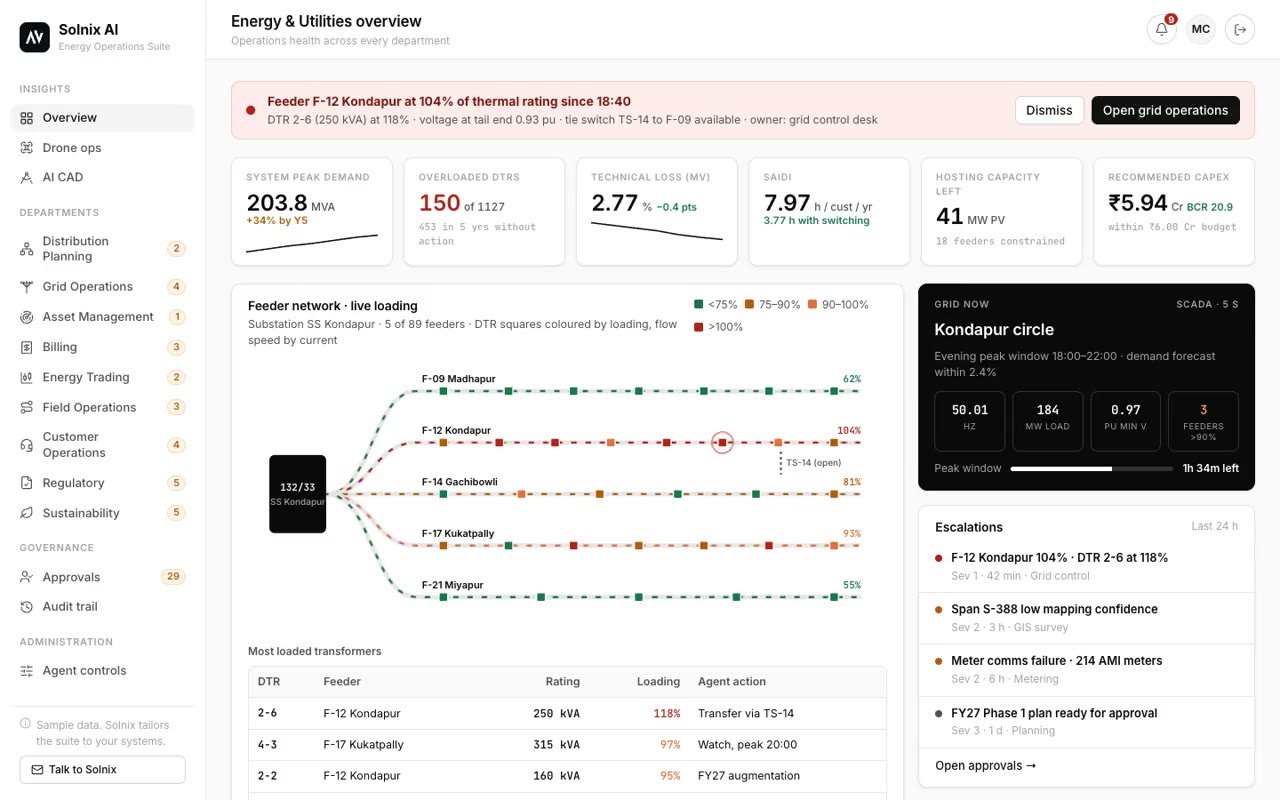
Energy & Utilities: The Solnix Agent Suite in Depth
Domain context, regulation, and a full playbook for each of the 9 departments: agents, checkpoints, measures, systems and a pilot plan.
Abstract
Electric distribution utilities plan and operate networks under regulators who set rates and reliability expectations. Load growth from electrification, rooftop solar and EV charging is changing where capacity is needed, while storms and asset ageing drive outages. This paper sets out the regulation and systems that shape the work, then walks through each of the 9 departments in the Solnix Energy & Utilities suite: what makes the work hard, what each agent does, who decides, what the dashboard tracks and how to pilot it. It closes with Drone ops, AI CAD, approvals, deployment and a comparison with the platforms energy teams already use.
Key findings
019 department playbooks, each with its trigger, agent steps, named checkpoint, dashboard measures and connected systems.
02Designed around IEEE 1366 and State public utility commission rate cases, among others.
03Decisions reserved for people stop in Approvals with every agent's evidence; every run is in the audit trail.
04Works alongside GE Vernova (GridOS / ADMS) and Schneider Electric (EcoStruxure ADMS) rather than replacing them.
The 9 departments of the Energy & Utilities suite and the workflow each one runs.
Inside this paper
Industry context and regulation
Load growth from electrification and EV charging concentrates on specific feeders and transformers. Reliability performance (SAIDI, SAIFI) is reported to regulators and often tied to incentives.
Department playbooks
Distribution Planning (AI Feeder Network Planner), Grid Operations (Outage Restoration Coordinator), Asset Management (Drone Inspection Analyst), Billing (Meter-to-Cash Exceptions), Energy Trading (Load & Price Forecaster), Field Operations (Crew Work Planner), Customer Operations (Outage & High Bill Comms), Regulatory (Rate Case Workbench), Sustainability (ESG & Emissions Reporter).
Deployment and comparison
Utilities buy ADMS, AMI, CIS and analysis platforms from established vendors.
The full paper, as 5 documents
Part 1Energy operations and the suiteThe industry's operating reality, regulation, systems and how the suite maps to its departments.5 pp
Part 2Department playbooks, part 1Distribution Planning, Grid Operations, Asset Management, Billing, Energy Trading14 pp
Part 3Department playbooks, part 2Field Operations, Customer Operations, Regulatory, Sustainability11 pp
Part 4Drone ops, AI CAD, approvals and CopilotWhat the Energy suite does in the field and on the drawing board, and how people stay in charge.6 pp
Part 5Deployment, track record and comparisonHow a energy deployment runs, what Solnix has built, and the alternatives.3 pp
Energy & UtilitiesSolnix EnterpriseDepartment playbooksCompetitor comparison
+
IndustryOctober 2026· 5 documents · 35 pages
Hospitality & Travel: The Solnix Agent Suite in Depth
Domain context, regulation, and a full playbook for each of the 8 departments: agents, checkpoints, measures, systems and a pilot plan.
Abstract
Hotels sell a perishable product: a room-night unsold tonight is lost. Revenue managers set rates by date, segment and channel; front office and housekeeping turn rooms; food and beverage controls cost and waste; group sales weighs events against transient demand. This paper sets out the regulation and systems that shape the work, then walks through each of the 8 departments in the Solnix Hospitality & Travel suite: what makes the work hard, what each agent does, who decides, what the dashboard tracks and how to pilot it. It closes with Drone ops, AI CAD, approvals, deployment and a comparison with the platforms hospitality teams already use.
Key findings
018 department playbooks, each with its trigger, agent steps, named checkpoint, dashboard measures and connected systems.
02Designed around PCI DSS and Privacy laws (GDPR, CCPA), among others.
03Decisions reserved for people stop in Approvals with every agent's evidence; every run is in the audit trail.
04Works alongside Oracle OPERA Cloud and IDeaS rather than replacing them.
The 8 departments of the Hospitality & Travel suite and the workflow each one runs.
Inside this paper
Industry context and regulation
Rate strategy across direct and OTA channels with parity obligations. Guest expectations for instant messaging responses.
Hotels use a PMS plus revenue management and reputation platforms.
The full paper, as 5 documents
Part 1Hospitality operations and the suiteThe industry's operating reality, regulation, systems and how the suite maps to its departments.4 pp
Part 2Department playbooks, part 1Revenue Management, Front Office, Housekeeping, Food & Beverage11 pp
Part 3Department playbooks, part 2Group Sales, Reputation, Loyalty Marketing, Finance12 pp
Part 4Drone ops, AI CAD, approvals and CopilotWhat the Hospitality suite does in the field and on the drawing board, and how people stay in charge.5 pp
Part 5Deployment, track record and comparisonHow a hospitality deployment runs, what Solnix has built, and the alternatives.3 pp
Legal & Professional Services: The Solnix Agent Suite in Depth
Domain context, regulation, and a full playbook for each of the 8 departments: agents, checkpoints, measures, systems and a pilot plan.
Abstract
Law firms and legal departments sell expertise by the hour or by the matter, yet a large share of time goes into reading, comparing and assembling: contract review, document review in discovery, conflict checks, precedent research, billing guidelines. This paper sets out the regulation and systems that shape the work, then walks through each of the 8 departments in the Solnix Legal & Professional Services suite: what makes the work hard, what each agent does, who decides, what the dashboard tracks and how to pilot it. It closes with Drone ops, AI CAD, approvals, deployment and a comparison with the platforms legal teams already use.
Key findings
018 department playbooks, each with its trigger, agent steps, named checkpoint, dashboard measures and connected systems.
02Designed around ABA Model Rules 1.1, 1.6 and 5.3 and ABA Formal Opinion 512 (2024), among others.
03Decisions reserved for people stop in Approvals with every agent's evidence; every run is in the audit trail.
04Works alongside Harvey and Thomson Reuters CoCounsel rather than replacing them.
The 8 departments of the Legal & Professional Services suite and the workflow each one runs.
Inside this paper
Industry context and regulation
Clients push back on bills and require compliance with billing guidelines. Discovery volumes grow with email, chat and collaboration data.
Legal AI includes specialist assistants, research platforms and eDiscovery suites.
The full paper, as 5 documents
Part 1Legal operations and the suiteThe industry's operating reality, regulation, systems and how the suite maps to its departments.4 pp
Part 2Department playbooks, part 1Transactions, Litigation, Intake, Billing12 pp
Part 3Department playbooks, part 2Knowledge, Business Development, Compliance, Finance11 pp
Part 4Drone ops, AI CAD, approvals and CopilotWhat the Legal suite does in the field and on the drawing board, and how people stay in charge.5 pp
Part 5Deployment, track record and comparisonHow a legal deployment runs, what Solnix has built, and the alternatives.3 pp
Legal & Professional ServicesSolnix EnterpriseDepartment playbooksCompetitor comparison
+
IndustryOctober 2026· 5 documents · 36 pages
Government & Public Sector: The Solnix Agent Suite in Depth
Domain context, regulation, and a full playbook for each of the 8 departments: agents, checkpoints, measures, systems and a pilot plan.
Abstract
Public agencies serve everyone, under statutory deadlines, procurement rules and open-records laws, often with legacy systems and constrained budgets. Residents expect the responsiveness of consumer services, while every decision must be fair, explainable and on the record. This paper sets out the regulation and systems that shape the work, then walks through each of the 8 departments in the Solnix Government & Public Sector suite: what makes the work hard, what each agent does, who decides, what the dashboard tracks and how to pilot it. It closes with Drone ops, AI CAD, approvals, deployment and a comparison with the platforms gov teams already use.
Key findings
018 department playbooks, each with its trigger, agent steps, named checkpoint, dashboard measures and connected systems.
02Designed around FOIA and state public records laws and SNAP and Medicaid processing rules, among others.
03Decisions reserved for people stop in Approvals with every agent's evidence; every run is in the audit trail.
04Works alongside Salesforce Public Sector Solutions and Tyler Technologies rather than replacing them.
The 8 departments of the Government & Public Sector suite and the workflow each one runs.
Inside this paper
Industry context and regulation
Service requests and calls arrive in many languages and channels. Permit backlogs delay housing and business investment.
Department playbooks
Citizen Services (311 Service Agent), Permits & Licensing (Permit Plan Review), Social Services (Benefits Eligibility Assistant), Procurement (RFP Evaluation Assistant), Public Safety (Dispatch Assist), Records (Public Records Request Desk), Finance (Grants Management), Human Resources (Civil Service Hiring).
Deployment and comparison
Agencies use platform vendors and government-specific software.
The full paper, as 5 documents
Part 1Gov operations and the suiteThe industry's operating reality, regulation, systems and how the suite maps to its departments.5 pp
Part 2Department playbooks, part 1Citizen Services, Permits & Licensing, Social Services, Procurement12 pp
Part 3Department playbooks, part 2Public Safety, Records, Finance, Human Resources11 pp
Part 4Drone ops, AI CAD, approvals and CopilotWhat the Gov suite does in the field and on the drawing board, and how people stay in charge.5 pp
Part 5Deployment, track record and comparisonHow a gov deployment runs, what Solnix has built, and the alternatives.3 pp
Government & Public SectorSolnix EnterpriseDepartment playbooksCompetitor comparison
+
IndustryOctober 2026· 5 documents · 37 pages
Pharma & Life Sciences: The Solnix Agent Suite in Depth
Domain context, regulation, and a full playbook for each of the 8 departments: agents, checkpoints, measures, systems and a pilot plan.
Abstract
Pharma and life sciences companies operate under GxP rules from discovery to distribution. Clinical trials need eligible patients and active sites; pharmacovigilance must process adverse events on regulatory clocks; regulatory affairs assembles submissions; manufacturing releases batches only after review; cold chain keeps product within temperature. This paper sets out the regulation and systems that shape the work, then walks through each of the 8 departments in the Solnix Pharma & Life Sciences suite: what makes the work hard, what each agent does, who decides, what the dashboard tracks and how to pilot it. It closes with Drone ops, AI CAD, approvals, deployment and a comparison with the platforms pharma teams already use.
Key findings
018 department playbooks, each with its trigger, agent steps, named checkpoint, dashboard measures and connected systems.
02Designed around ICH E6 Good Clinical Practice and ICH E2B(R3) and expedited reporting rules, among others.
03Decisions reserved for people stop in Approvals with every agent's evidence; every run is in the audit trail.
04Works alongside Veeva Systems and IQVIA rather than replacing them.
The 8 departments of the Pharma & Life Sciences suite and the workflow each one runs.
Inside this paper
Industry context and regulation
Trial enrolment delays extend timelines. Adverse event volumes from many sources must meet reporting deadlines.
Life sciences companies standardise on validated platforms for clinical, safety, regulatory and commercial work.
The full paper, as 5 documents
Part 1Pharma operations and the suiteThe industry's operating reality, regulation, systems and how the suite maps to its departments.5 pp
Part 2Department playbooks, part 1Clinical Operations, Pharmacovigilance, Regulatory Affairs, Manufacturing Quality12 pp
Part 3Department playbooks, part 2Medical Affairs, Commercial, Supply Chain, R&D11 pp
Part 4Drone ops, AI CAD, approvals and CopilotWhat the Pharma suite does in the field and on the drawing board, and how people stay in charge.6 pp
Part 5Deployment, track record and comparisonHow a pharma deployment runs, what Solnix has built, and the alternatives.3 pp
Pharma & Life SciencesSolnix EnterpriseDepartment playbooksCompetitor comparison
+
IndustryOctober 2026· 5 documents · 37 pages
Aerospace & Defense: The Solnix Agent Suite in Depth
Domain context, regulation, and a full playbook for each of the 8 departments: agents, checkpoints, measures, systems and a pilot plan.
Abstract
Aerospace and defense operate under airworthiness authorities, quality standards and export controls. MRO shops race aircraft-on-ground events; aerostructures lines run to takt with strict build quality; programmes track contract milestones; lessors manage aircraft returns with complete records. This paper sets out the regulation and systems that shape the work, then walks through each of the 8 departments in the Solnix Aerospace & Defense suite: what makes the work hard, what each agent does, who decides, what the dashboard tracks and how to pilot it. It closes with Drone ops, AI CAD, approvals, deployment and a comparison with the platforms aerospace teams already use.
Key findings
018 department playbooks, each with its trigger, agent steps, named checkpoint, dashboard measures and connected systems.
02Designed around EASA Part-145 and FAA Part 145 and AS9100D, among others.
03Decisions reserved for people stop in Approvals with every agent's evidence; every run is in the audit trail.
04Works alongside Swiss-AS AMOS / TRAX / Ramco and IFS rather than replacing them.
The 8 departments of the Aerospace & Defense suite and the workflow each one runs.
Inside this paper
Industry context and regulation
AOG events are costly and time-critical. Build quality and takt adherence on aerostructures lines.
Domain context, regulation, and a full playbook for each of the 8 departments: agents, checkpoints, measures, systems and a pilot plan.
Abstract
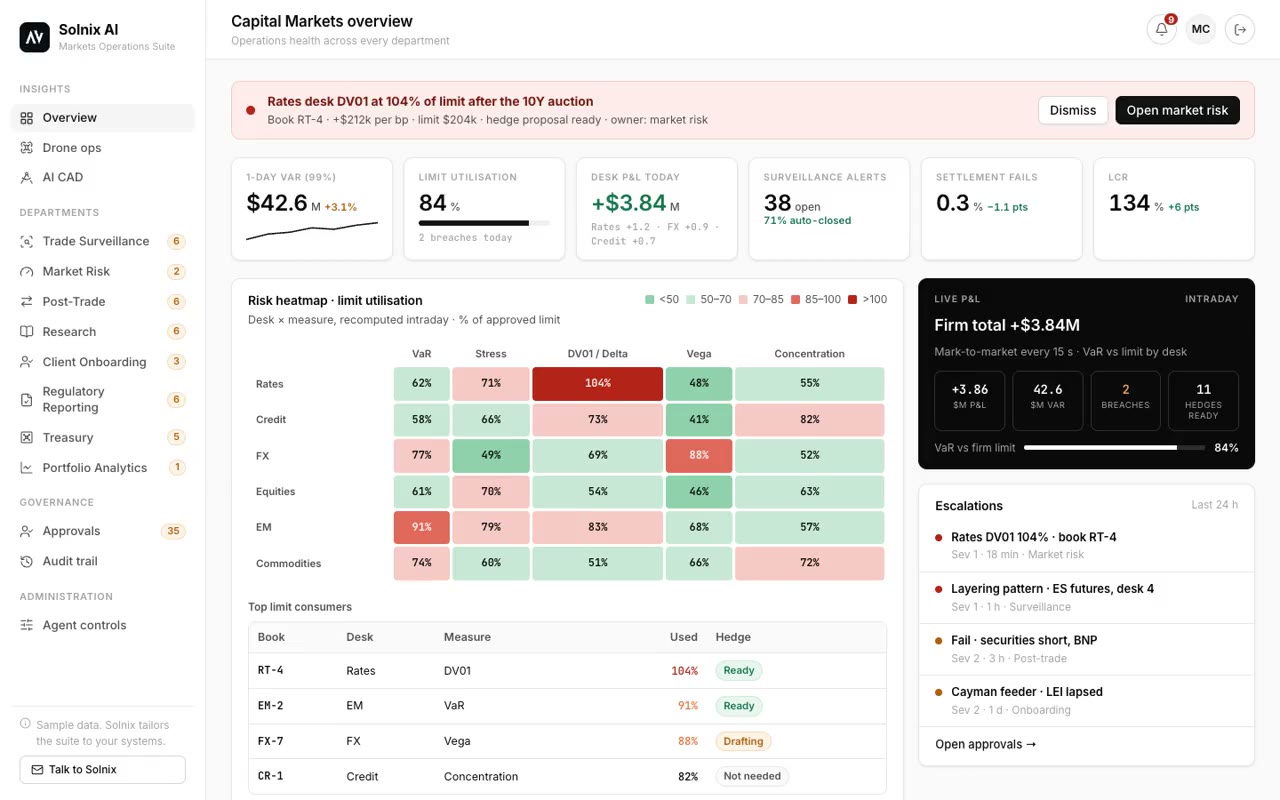
Capital markets firms run trading, risk, operations and compliance under intense regulatory scrutiny. Surveillance must catch market abuse; risk must stay inside limits intraday; trade breaks must be fixed before settlement; regulatory reports must be complete and timely. This paper sets out the regulation and systems that shape the work, then walks through each of the 8 departments in the Solnix Capital Markets suite: what makes the work hard, what each agent does, who decides, what the dashboard tracks and how to pilot it. It closes with Drone ops, AI CAD, approvals, deployment and a comparison with the platforms markets teams already use.
Key findings
018 department playbooks, each with its trigger, agent steps, named checkpoint, dashboard measures and connected systems.
02Designed around EU Market Abuse Regulation and US anti-spoofing rules and SEC Consolidated Audit Trail (CAT), among others.
03Decisions reserved for people stop in Approvals with every agent's evidence; every run is in the audit trail.
04Works alongside NICE Actimize and Nasdaq Trade Surveillance rather than replacing them.
The 8 departments of the Capital Markets suite and the workflow each one runs.
Inside this paper
Industry context and regulation
Shorter settlement cycles leave less time to fix breaks. Surveillance alert volumes and false positives.
Firms use specialist surveillance, risk and post-trade platforms.
The full paper, as 5 documents
Part 1Markets operations and the suiteThe industry's operating reality, regulation, systems and how the suite maps to its departments.5 pp
Part 2Department playbooks, part 1Trade Surveillance, Market Risk, Post-Trade, Research11 pp
Part 3Department playbooks, part 2Client Onboarding, Regulatory Reporting, Treasury, Portfolio Analytics11 pp
Part 4Drone ops, AI CAD, approvals and CopilotWhat the Markets suite does in the field and on the drawing board, and how people stay in charge.5 pp
Part 5Deployment, track record and comparisonHow a markets deployment runs, what Solnix has built, and the alternatives.3 pp
Capital MarketsSolnix EnterpriseDepartment playbooksCompetitor comparison
+
IndustryOctober 2026· 5 documents · 36 pages
Automotive: The Solnix Agent Suite in Depth
Domain context, regulation, and a full playbook for each of the 8 departments: agents, checkpoints, measures, systems and a pilot plan.
Abstract
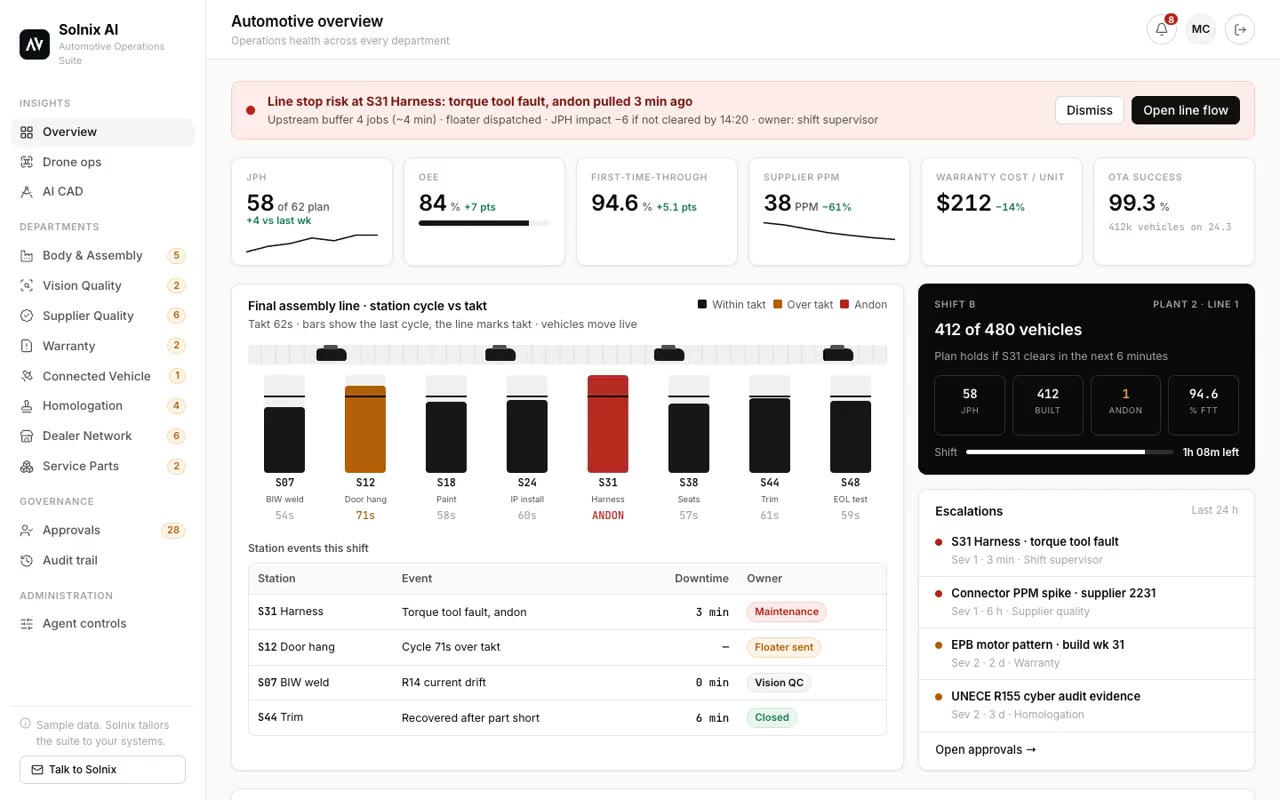
Automakers and suppliers run lines to takt, chase defects before they ship, manage supplier quality and connected-vehicle software across fleets, and meet homologation requirements in each market. This paper sets out the regulation and systems that shape the work, then walks through each of the 8 departments in the Solnix Automotive suite: what makes the work hard, what each agent does, who decides, what the dashboard tracks and how to pilot it. It closes with Drone ops, AI CAD, approvals, deployment and a comparison with the platforms automotive teams already use.
Key findings
018 department playbooks, each with its trigger, agent steps, named checkpoint, dashboard measures and connected systems.
02Designed around IATF 16949 and AIAG PPAP and APQP, among others.
03Decisions reserved for people stop in Approvals with every agent's evidence; every run is in the audit trail.
04Works alongside Siemens Opcenter / Dassault DELMIA and Cognex rather than replacing them.
The 8 departments of the Automotive suite and the workflow each one runs.
Inside this paper
Industry context and regulation
Line stoppages and takt adherence. Paint and weld quality before vehicles leave the plant.
A structured method for assessing AI opportunity, data maturity and organisational readiness before committing to AI investment.
Abstract
Many enterprises approach AI by starting with a technology and working backwards to a problem. This paper presents a framework for identifying, prioritising and sizing AI opportunities before technical decisions are made, so the result is a roadmap boards can fund in stages and operations teams can execute.
Key findings
01Start from a ranked backlog of business processes, not from a model or platform choice.
02Score each use case on four dimensions; a high-value use case can still fail on data maturity.
03Fund in phases, each with an owner and an explicit success test.
04Industry starting points (such as the Solnix Enterprise suites) shorten the inventory step.
From inventory to the first shipped system.
Inside this paper
Why AI initiatives stall before production
Selecting a model first inverts the value chain; start with an inventory of processes scored on value, data and feasibility.
The four readiness dimensions
Opportunity clarity, data maturity, organisational capability and governance readiness.
A board-fundable roadmap
Phases with an owner, a success test and an evidence-based estimate.
The full paper, as 2 documents
Part 1The frameworkThe four dimensions and how to score them.3 pp
Part 2Building the roadmap, track record and comparisonFrom scores to a phased, fundable plan, and who can help.3 pp
AI strategyReadinessRoadmap
+
TechnicalApril 2026· 2 documents · 6 pages
Multi-Agent Orchestration at Enterprise Scale
Design patterns for reliable, governable multi-agent systems: failure handling, human-in-the-loop design and cost control.
Abstract
Specialised agents that delegate and verify each other's work can handle workflows a single prompt cannot. They also add new failure modes. This paper covers when multiple agents are worth it, the orchestration patterns that survive production, and the governance that keeps autonomous systems accountable, drawing on how the Solnix Enterprise suites are built.
Key findings
01Use multiple agents only when a workflow has genuinely distinct sub-tasks needing different tools, context or judgement.
02Unbounded delegation loops are a common production failure; bound them with budgets and timeouts.
03A fixed pipeline of narrow agents is the easiest pattern to test and audit.
04Human checkpoints at decisions people own are a design element, not a fallback.
The governed run pattern used in Solnix Enterprise.
Inside this paper
When to reach for multiple agents
A decision rubric for one model with tools versus orchestration.
Patterns that survive production
Supervisor-worker, pipeline and blackboard, with their failure modes.
Governance for autonomous systems
Policy layers, role-based tool access, audit logging and checkpoints.
The full paper, as 2 documents
Part 1When and how to orchestrateThe decision rubric and the three patterns.3 pp
Part 2Governance, track record and comparisonKeeping autonomous systems accountable, and the build options.3 pp
Agent systemsArchitectureGovernance
+
TechnicalMarch 2026· 2 documents · 5 pages
RAG System Design for Enterprise Knowledge
Building retrieval-augmented generation that is accurate, fast and maintainable at enterprise document scale.
Abstract
Retrieval-augmented generation is the dominant pattern for AI that must reason over a company's own knowledge. Most failures come from retrieval, not the language model: the wrong passages come back, the system answers when it should refuse, or latency makes it unusable. This paper covers the architecture decisions that separate production RAG from a proof of concept.
Key findings
01Fix retrieval first; swapping the language model rarely fixes a retrieval problem.
02Hybrid retrieval (semantic plus keyword) with re-ranking is a strong default for enterprise corpora.
03Citing the source passage for every claim is the most practical defence against hallucination.
04Retrieval must respect the asking user's access rights.
Inside this paper
The retrieval problem is the real problem
Chunking, embeddings, hybrid search and re-ranking move accuracy most.
Defending against hallucination
Confidence thresholds, citation grounding and answerability checks.
Operating at document scale
Freshness, incremental updates, access-aware retrieval and latency budgets.
The full paper, as 2 documents
Part 1Retrieval and groundingThe pipeline and the levers that matter.2 pp
Part 2Operating RAG, track record and comparisonRunning it at scale, and build-versus-buy options.3 pp
RAGKnowledge systemsLLM
+
TechnicalDecember 2025· 2 documents · 5 pages
LLM Evaluation for Production Enterprise Systems
Evaluating models beyond benchmark scores, for accuracy, safety, latency and cost in real deployment conditions.
Abstract
Public benchmarks such as MMLU, HumanEval and GSM8K measure general capability on academic tasks. The questions that matter in production are different: how the model behaves on your domain's edge cases, how often it is wrong on your documents, and what latency and cost look like at your volumes. This paper presents an evaluation method built for deployment decisions.
Key findings
01Public benchmark scores say little about performance on your domain's edge cases.
02A domain-specific evaluation set built from real cases is one of the most valuable assets an AI team owns.
03LLM-as-judge is useful only when calibrated against human grading.
04Latency and cost at your usage volume are deployment-deciding factors benchmarks never show.
Inside this paper
Why public benchmarks mislead
They measure academic tasks, not your edge cases, corpus or scale.
Building an evaluation harness
Representative eval sets, graded rubrics and regression tracking.
Making the deployment decision
A scorecard of accuracy, safety, latency and cost.
The full paper, as 2 documents
Part 1Building the evaluation harnessFrom real cases to a repeatable test.2 pp
Part 2Making the decision, track record and comparisonTurning results into a choice, and the tooling options.3 pp
LLM evaluationTestingProduction AI
+
StrategyNovember 2025· 2 documents · 6 pages
The AI Governance Imperative
Building control infrastructure for enterprise AI before regulators require it: a practical guide for CIOs, CDOs and general counsel.
Abstract
Regulation is converging on the same expectations: documented controls, testing, explainability and human oversight. The EU AI Act's obligations phase in from 2025 onwards, and frameworks such as the NIST AI Risk Management Framework and ISO/IEC 42001 give organisations a structure to follow. This paper sets out the control infrastructure to build once, proactively, so every new use case inherits it.
Key findings
01Regulatory expectations are converging on documented controls, testing, explainability and human oversight.
02A registry of models and agents, with owners and purposes, is the foundation of audit readiness.
03Human checkpoints and per-run audit trails turn governance from a review into a property of the system.
04Governance built once lets new use cases ship faster because they inherit the controls.
Governance built into the run, not added after it.
Inside this paper
The regulatory landscape is converging
EU AI Act, NIST AI RMF and ISO/IEC 42001 point the same way.
The control infrastructure you need
Policy, registry, testing, checkpoints, monitoring and audit.
Governance as an accelerant
Every new use case inherits the controls.
The full paper, as 2 documents
Part 1The control infrastructureWhat to build, layer by layer.3 pp
Part 2Governance in practice, track record and comparisonHow controls look inside a running system.3 pp
GovernanceEU AI ActRisk management
+
OperationsOctober 2025· 2 documents · 5 pages
Automating the Hard Part: AI-First Process Design
Redesigning operational workflows around AI, beyond RPA and rules, so AI handles ambiguity and people handle real exceptions.
Abstract
Rule-based automation handles the steps that are perfectly structured and never change. Judgement calls, exceptions and unstructured documents still fall to people, and that is where most operational cost sits. AI-first process design assumes AI handles most steps and designs the human hand-off for the exceptions that genuinely need judgement.
Key findings
01RPA and rules cover structured steps; the cost sits in judgement calls and exceptions.
02The most important design decision is where the human hand-off sits.
03Exception handling, not the happy path, decides whether a redesign succeeds.
04Straight-through rate, exception rate and review load are the operating measures.
The resulting run pattern.
Inside this paper
The limits of rule-based automation
Rules handle structure; people still handle ambiguity.
Designing AI-first workflows
Map, redesign and instrument the human-AI hand-off.
Measuring and improving
Feedback shrinks the exception set over time.
The full paper, as 2 documents
Part 1The methodFrom process map to redesigned workflow.3 pp
Part 2Measuring, track record and comparisonThe operating measures, and how this differs from RPA.2 pp
Process automationOperations AIWorkflow design
+
See it working
Read the paper, then tour the product.
Every industry suite can be toured for 14 days on sample data. Or book a consultation and we'll go through the paper against your own systems.